On this page
- How much does Talabat charge restaurants?
- What else comes out of a Talabat order?
- The margin maths: why a 25% order can still lose money
- How do you set up a restaurant on Talabat?
- How to protect your margins on Talabat
- Should you run direct ordering alongside Talabat?
- Frequently Asked Questions
- Own more of your delivery demand
Talabat commission for restaurants in the UAE is publicly reported at roughly 15% to 30% of order value, and most independent operators sit between 20% and 25%. On a AED 100 order that is AED 20 to AED 25 gone before you have paid for a single ingredient, a box, or the chef who cooked it.
That number on its own does not tell you whether delivery makes money. Commission is the largest line in a stack that also includes promotion funding, payment processing and packaging, and the stack behaves very differently on a AED 45 order than on a AED 180 one. This guide covers what Talabat charges, what else leaves the till on every order, how to set the channel up properly, and the levers that decide whether aggregator demand is profit or just volume.
How much does Talabat charge restaurants?
Talabat does not publish a rate card. Commission is negotiated per venue, so two restaurants on the same street can sit several points apart. The publicly reported range for the UAE runs from about 15% to 30% of order value, with most independent restaurants landing in the 20% to 25% band.
Local reporting puts the wider aggregator market slightly higher. Khaleej Times has reported that delivery aggregators in the UAE charge between 25% and 30%, and in some cases up to 35% of order value. Treat any published figure as a starting point rather than your rate: the only number that matters is the one in your signed commercial terms.
Four things move the number you are offered:
- Order volume. Steady, growing volume is the strongest thing you can bring to a rate conversation.
- Exclusivity. Listing with one platform instead of several usually buys a few points back.
- Who delivers. Rates differ when the platform's riders deliver versus when you deliver yourself.
- Category and location. Cuisine, average basket and area all feed the rate you are offered.
Group buying power matters too. Trade bodies negotiate on behalf of members, and Dubai Restaurants Group has arranged discounted platform fees for its members in the past. If you are a single independent venue, that is often the cheapest few points available to you.
What else comes out of a Talabat order?
Commission is the headline. It is rarely the whole bill. Budget for:
- Promotion funding. Discounts and "buy one get one" campaigns are usually paid for by the restaurant, not the platform. Khaleej Times has reported the same pattern: the operator funds the offer that the customer reads as the app's generosity.
- In-app advertising. Paid placement to surface higher in a crowded category.
- Payment processing. Card fees, either bundled into commission or billed separately.
- Packaging. Delivery packaging costs more than a dine-in plate and scales with every single order.
- Onboarding and content. Menu build and photography, sometimes included, sometimes not.
Dubai has since issued guidelines requiring clearer online pricing from delivery platforms, which helps customers understand what they are paying. It does not change what leaves your side of the ledger, so you still need to model it yourself.
The margin maths: why a 25% order can still lose money
Take a AED 100 order at 25% commission. Food cost at 30% is AED 30. Packaging is AED 4. Commission is AED 25. Now run a 20% promotion that you fund, and another AED 20 leaves. You are carrying AED 79 of cost on a AED 100 order before rent, labour or utilities, and the order that felt like growth contributed AED 21 toward fixed costs that are considerably larger than that.
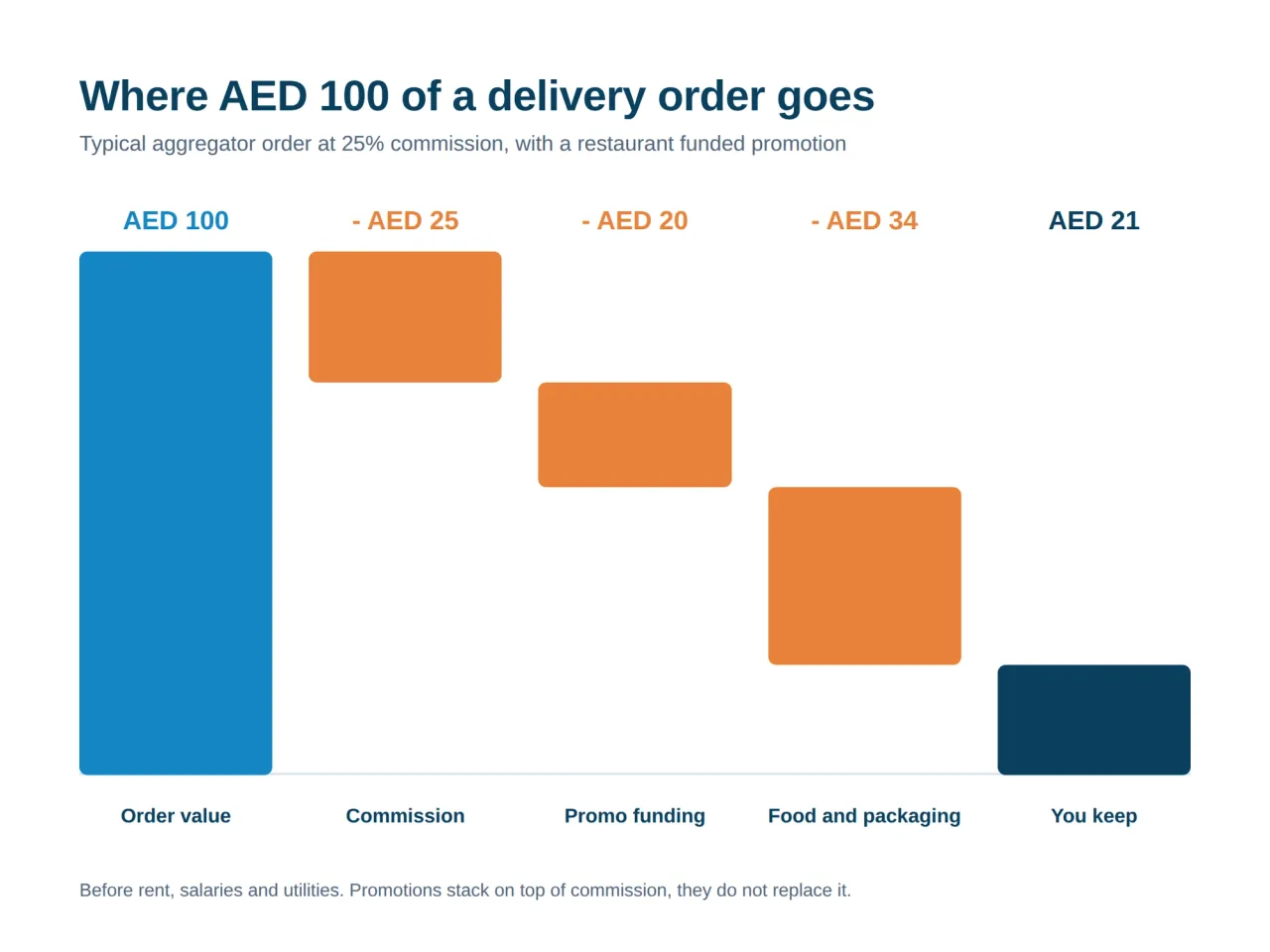
Two things follow. First, promotions are the most dangerous line, because they stack on top of commission rather than replacing it. Second, small baskets are where aggregator orders quietly go negative: packaging and prep time do not shrink with the ticket. If you have not built a per-channel margin model yet, start with your food cost percentage and layer the channel costs on top of it.
How do you set up a restaurant on Talabat?
- Agree commercial terms first. Commission, promotion commitments, delivery arrangement and notice period. Get the full fee list in writing, not just the headline rate.
- Submit your documentation. UAE food businesses need a valid trade licence and current food safety approvals.
- Build a delivery-specific menu. Not a copy of your dine-in menu, for the reasons below.
- Get proper photography. Photographed items outsell unphotographed ones on every aggregator, consistently.
- Set honest prep times. Optimistic times generate late orders and poor ratings, which cost more than the minutes you saved.
- Integrate with your POS. Aggregator orders should land in the same queue as everything else.
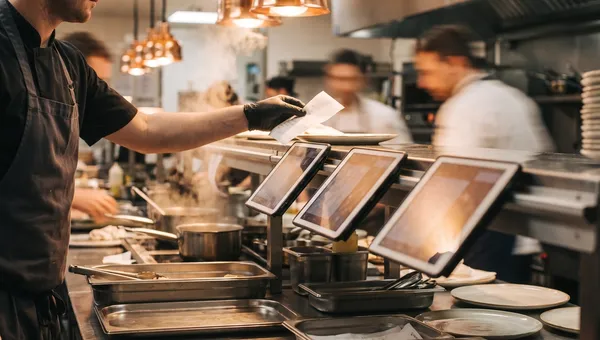
That last step is the one operators skip and later regret. A separate tablet per platform means somebody retypes orders into the till at the busiest moment of service, which is exactly where mistakes and refunds come from. Pushing every channel through one restaurant order management system removes the retyping and gives you channel-level reporting you can actually negotiate with.
How to protect your margins on Talabat
Price the delivery menu as its own menu
Delivery has a different cost structure, so it deserves different prices. Most operators uplift delivery prices to absorb part of the commission. Uplift too far and you lose the basket. Do not uplift at all and you fund the platform out of your own margin. Model it item by item instead of applying one blanket percentage across the menu.
Cut the dishes that travel badly
Every menu has items that arrive worse than they left. They generate refunds, one-star reviews and lost repeat orders, all of which cost more than the dish earns. Delivery menus should be shorter than dine-in menus, and the cut list should be decided by how food survives twenty minutes in a bag.
Negotiate with data, not frustration
Go into a rate conversation with your numbers: monthly volume, average basket, growth trend, cancellation rate and how much promotion you have funded. Platforms respond to accounts that are growing and well run. "Your commission is too high" is not a negotiating position. "We grew 40% year on year and funded AED 60,000 of promotions" is.
Use the aggregator for discovery, not for loyalty
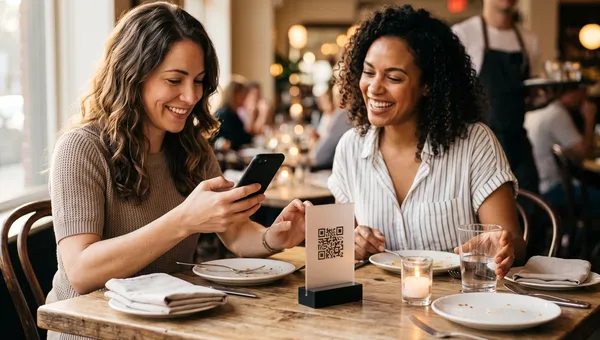
The platform is very good at putting you in front of someone who has never eaten your food. It is not the right place to keep them. A QR ordering flow at the table, a well designed insert in the delivery bag and a genuine reason to come back will move repeat customers onto a channel you own.
We kept a 24% aggregator deal on the table for a year because the discovery was genuinely working. What changed the maths was not the commission, it was moving repeat customers off it. Once about a third of our orders came direct, the aggregator stopped being a tax and started being a marketing cost I could justify.
Should you run direct ordering alongside Talabat?
For most UAE restaurants the answer is both, not either. Aggregators own discovery and convenience, and walking away from that on principle usually costs more than the commission does. The mistake is treating the aggregator as your entire delivery strategy, because every repeat customer you leave there is one you rent rather than own.
The comparison is worth doing properly. We broke down the trade-offs in direct online ordering versus third-party delivery apps, and if you are choosing a direct channel, our guide to commission-free online ordering systems covers what to look for. For the wider platform landscape, see our guide to on-demand delivery platforms.
A realistic target for an established venue is to move 25% to 40% of delivery orders direct within a year. That does not remove the aggregator from your business. It changes your negotiating position considerably the next time the rate comes up for review.
Frequently Asked Questions
How much does Talabat charge restaurants?
Publicly reported rates run from about 15% to 30% of order value, with most independent UAE restaurants between 20% and 25%. Talabat does not publish a rate card, so your actual rate is set in your commercial terms and depends on volume, exclusivity, category and who handles delivery.
How do restaurants reduce aggregator fees?
Four levers work in practice: negotiate using volume and growth data, price the delivery menu to absorb part of the commission, stop funding promotions that do not produce repeat customers, and build a direct ordering channel so a share of demand never pays commission at all.
Can you negotiate your Talabat commission?
Yes. Rates are set per venue rather than fixed across the market. Volume, exclusivity and a clean operational record are the strongest arguments you can bring. Membership of a trade body can help too, since group agreements have secured discounted fees for members.
Is it still worth being on Talabat?
For most restaurants, yes, as a discovery channel. Aggregators reach customers you would never otherwise meet. The real question is not whether to list, it is what share of your delivery revenue you are willing to rent permanently.
Own more of your delivery demand
Quickbuy gives restaurants a commission-free direct ordering channel, QR ordering at the table, and one order queue for every channel, so aggregator orders and direct orders land in the same place. See Quickbuy pricing or talk to us about moving a share of your delivery volume onto a channel you own.