The safest way to raise menu prices is dish by dish, not across the board. Reprice the dishes whose costs actually moved, in steps of about 3 to 5 percent, and leave the handful of items your regulars use as a price benchmark for last. Guests notice a new total on the burger they order every Friday. They rarely notice a side, a sauce or a house specialty moving by a couple of dirhams.
The pressure is real. In the US, prices for food away from home were 3.4% higher in July 2026 than a year earlier, and USDA's latest food price outlook forecasts a 3.6% rise for the full year, with retail beef prices expected to climb 9.8% while poultry barely moves (0.5%). If your costs went up and your menu didn't, you've already taken a pay cut. This guide covers how much to raise, which dishes to touch first, what to do instead of raising, how to handle guests, and how to measure whether it worked.
Why most restaurants need a menu price increase in 2026
Your menu price is the one cost lever you fully control. Suppliers, landlords and delivery apps reprice you whenever they like. Your menu only changes when you decide it should. The trouble is that most owners wait until the gap is obvious, then fix it with one big jump.
Run the numbers before you decide. If a dish's food cost has drifted from 30% to 34% of its price, those 4 points come straight out of the profit on every plate. Check the food cost percentage of each dish first, because the average across your whole menu hides the dishes doing the damage.
Small, regular increases read as normal. A 12% jump after two years of silence reads as greed, and it's the one guests write reviews about.
How much should you raise menu prices?
Start from the plate, not from the restaurant down the road. The basic formula: target price = plate cost ÷ target food cost percentage. A dish that costs 15.40 AED to plate, at a 30% target, should sell for about 51 AED.
A worked example
Say your burger sold for 48 AED and the patty, bun and fries cost 14.00 AED to plate: a 29% food cost. Beef goes up and the plate cost becomes 15.40 AED. At 48 AED you're now at 32%. Getting back to 29% would need a price of 53 AED, a 10% jump in one move.
Split it instead. Move the burger to 50 AED now (a 4% increase and a 30.8% food cost) and find the last point somewhere else: a slightly smaller fries portion, a better price on buns, or a second step in six months.
Keep each step to about 3 to 5 percent
There's no law here, but single steps in that range tend to pass without comment, especially when they're spread across different items. It also sits close to what's happening to restaurant prices in general, so you don't look out of step with the market. If a dish needs 10%, take it in two moves or pair the increase with an upgrade guests can see.
Don't raise everything by the same percentage
A flat 5% across the menu is the lazy version. It pushes your cheap, high-volume items (the ones guests know by heart) up as hard as the dishes that actually got more expensive, and it leaves money on the table where you had room to move.
Which menu pricing strategy fits each part of your menu?
Different items can take different treatment. Before you touch a single price, sort your menu into these groups:
- Benchmark items. The burger, the flat white, the chicken biryani: the dishes guests compare across restaurants. Move them last and least.
- Cost-hit items. Anything built on the ingredients that moved most (beef, seafood, imported dairy). These go first.
- Signature dishes. If nobody else nearby makes it, nobody can compare the price. This is where you have the most room.
- Sides, add-ons and modifiers. Extra cheese, a sauce, a larger size. Small increases here are rarely noticed and add up fast.
- Drinks. Usually your lowest food cost category, so they don't need to rise just because food did.
If you've already plotted your items on the menu engineering matrix, use it here: stars (popular and profitable) can usually carry a modest increase, while dogs (unpopular and unprofitable) are better removed than repriced.
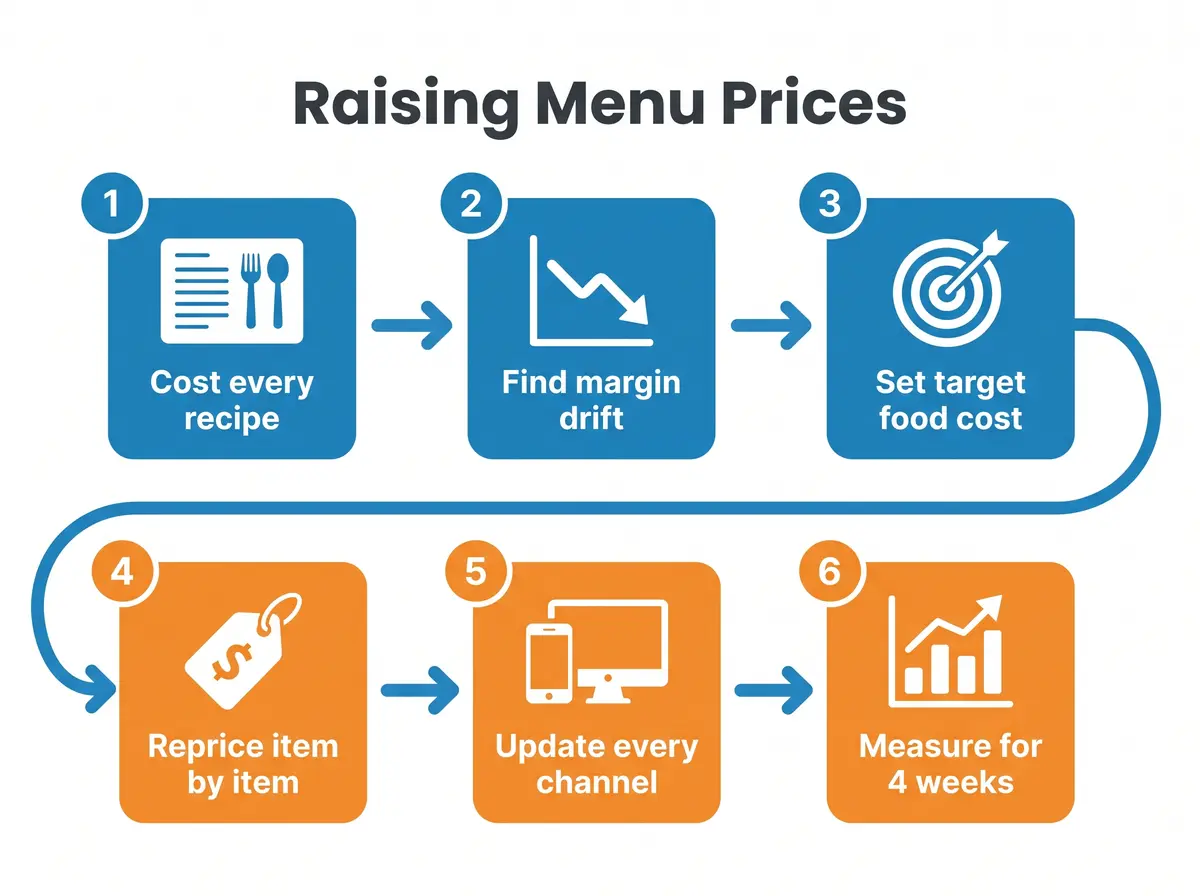
How to raise menu prices step by step
- Cost every recipe from current purchase prices. Not last year's invoice. If your costing lives in a spreadsheet nobody has opened since launch, this step is where the whole exercise pays for itself.
- Find the margin drift. Compare each dish's food cost today with its cost the last time you set its price, and rank the list by points lost.
- Set a target food cost for each category. Mains, starters, desserts and drinks shouldn't share one target.
- Reprice item by item. Use the formula, cap each step, and decide which items wait for the next round.
- Update every channel on the same day. Printed menu, QR menu, POS, takeaway page. A guest who sees two prices for one dish will trust neither.
- Measure for four weeks. Then decide whether the next round needs to happen at all.
Steps 1 and 5 are where most restaurants lose a week. In Quickbuy each menu item is a costed recipe, so recipe costing that follows your purchase prices shows the margin hit per dish as soon as a supplier invoice changes, and menu management that pushes one price to every channel means a change lands on the QR menu and the POS at the same moment.
How can restaurants absorb rising costs without raising prices?
Sometimes the right increase is zero, or smaller than the formula says. These moves win back margin without touching the price the guest sees:
- Re-spec one ingredient. A different cut, a local cheese instead of an imported one. Taste it with your team before it goes out.
- Tighten portions where guests leave food. Watch what comes back on plates. Trimming the fries nobody finishes is not the same as shrinking the steak.
- Nudge the mix. Put your highest-margin dishes where eyes land first, on the printed menu and at the top of each category on the QR menu.
- Build combos. A main with a drink and a side at a fair bundle price steers guests toward the items that carry your margin.
- Sell a little more per order. Well-timed suggestions raise your average order value without changing a single price.
None of these replaces a price increase when costs keep climbing, but together they can halve the increase you need. The wider list of cost levers is in our restaurant cost control guide.
How to tell customers about a price increase
Mostly, you don't. Announcing a price rise draws attention to something most guests would never have noticed. No “new price” stickers over the old ones, no apology note on the menu.
What you do need is an answer for your staff, because a regular will eventually ask. Keep it short and true: ingredient costs went up, we kept the recipe and the portion the same, and we moved the price as little as we could. That lands far better than a shrug.
Be careful with quiet portion cuts on signature dishes. Guests forgive a slightly higher price faster than a smaller plate they notice. And in the UAE, remember that displayed prices include 5% VAT, so the number on the menu is everything the guest pays: round to a clean VAT-inclusive figure, not one that looks like it came out of a calculator.
The price increase that costs owners the most is the one they delay. I see it every month: a kitchen sits on a beef cost rise for a whole quarter to avoid moving a burger by 3 dirhams, and in those three months the dish gives away more margin than the increase ever put at risk.
Zaid Widyan, Founder, Quickbuy
How to measure whether the price increase worked
Revenue is the wrong scoreboard, because it goes up after any increase even while you're losing guests. Compare the four weeks after the change with the four weeks before, item by item:
- Units sold of each repriced dish
- Gross profit per dish, not revenue per dish
- Covers and order count, to catch guests leaving rather than trading down
- Category mix, to see whether guests switched to cheaper items
Here's the number that calms most owners down. A 5% increase on a dish running at a 30% food cost can lose about 6.7% of its orders before it earns you less gross profit than before. If sales of that dish fell 2%, the increase worked. Item-level sales reports turn this into a ten-minute check instead of a weekend with a spreadsheet. Watch for seasonality too: if the change landed in Ramadan or the summer slowdown, also compare against the same weeks last year.
Frequently Asked Questions
How much should a restaurant raise menu prices?
Work it out per dish from plate cost and your target food cost percentage, then cap each step at roughly 3 to 5 percent. Dishes built on ingredients that jumped may need two steps. Benchmark items that guests compare across restaurants should move last and least.
How often should restaurants raise their prices?
Review your recipe costing every quarter and adjust prices once or twice a year in small steps. Regular, modest changes feel normal to guests. A single large increase after years without one is what triggers complaints.
How do restaurants absorb rising costs without losing customers?
They combine small, targeted price increases with margin work guests never see: re-specifying ingredients, trimming portions nobody finishes, promoting high-margin dishes and building combos. Raising prices dish by dish instead of across the board protects the items regulars benchmark you on.
Is it better to raise prices or reduce portion sizes?
For signature dishes, raise the price. Guests notice a smaller plate faster than a slightly higher number, and it costs you more trust. Portion cuts make sense only where food regularly comes back uneaten, such as oversized sides.
Should you tell customers about a menu price increase?
No public announcement is needed, and it usually draws attention to a change few guests would notice. Give your staff a short, honest answer for regulars who ask: costs went up, and the recipe and portion stayed the same.
Reprice with numbers, not nerves
Raising prices goes wrong when it runs on feel: one big jump, the wrong dishes, and no way to see what happened next. Quickbuy costs every menu item from your own purchase prices, shows you which dishes are leaking margin, and updates the QR menu and POS together when you change a price. See Quickbuy's plans and pricing and cost your menu before your next price change.