On this page
- How do you calculate food cost percentage?
- What is a good food cost percentage for your restaurant type?
- Where does your food cost actually leak?
- How does food inventory management lower your food cost?
- What should you look for in food inventory management software?
- How do you reduce food waste without changing your menu?
- Frequently Asked Questions
- Turn food cost into a number you control
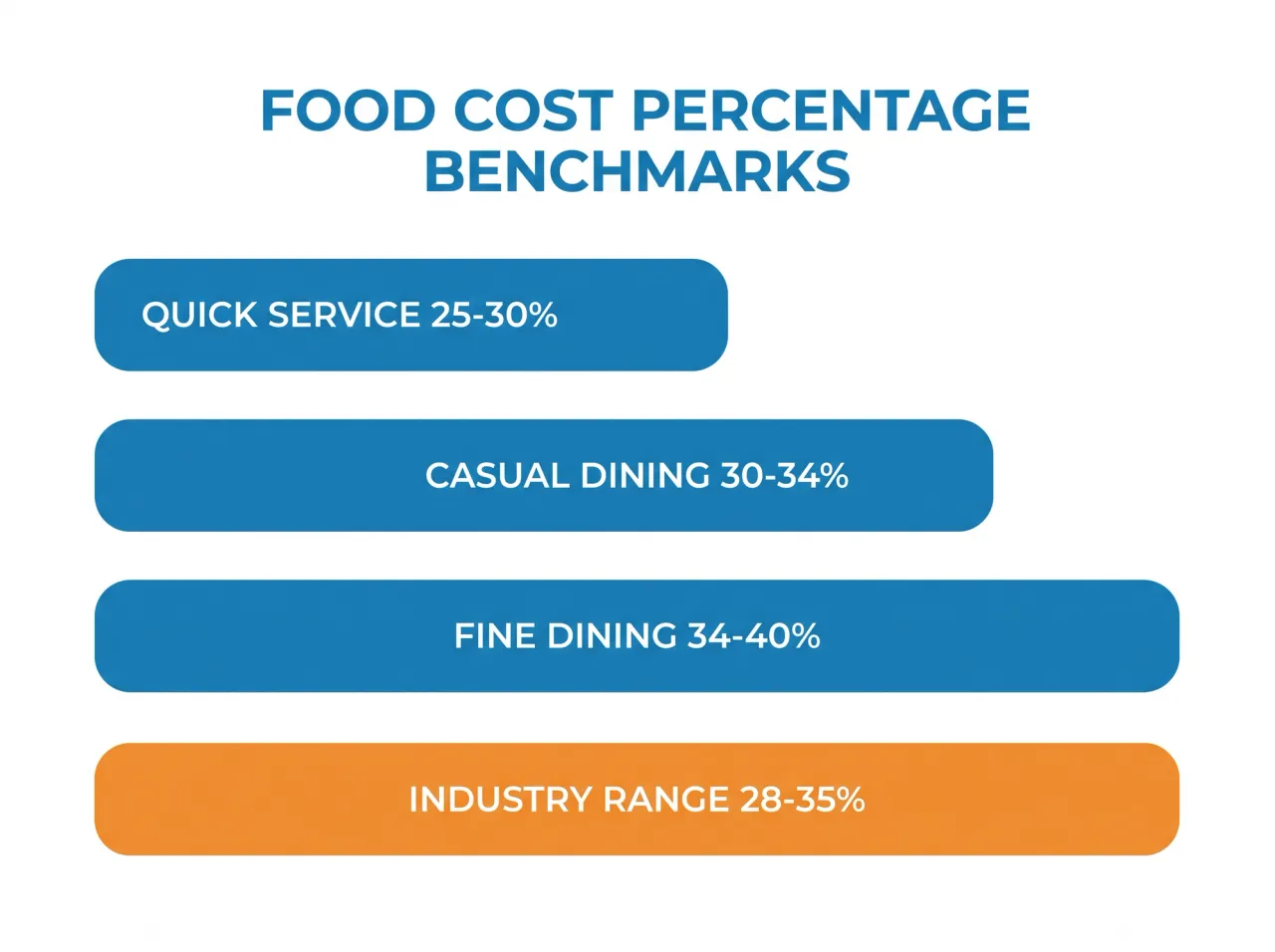
A healthy restaurant food cost percentage sits between 28 and 35 percent of food revenue. Quick service usually runs 25 to 30 percent, casual dining 30 to 34, and fine dining 34 to 40. If you're above your band and can't say why, the cause is rarely your menu prices. It's that nobody is counting what comes in and what goes out.
Food cost is the one number on your P&L that moves every week, and most owners only look at it every quarter. Good food inventory management closes that gap. This guide covers the formula, the benchmark for your service style, the five places margin actually leaks, and how to fix each one.
How do you calculate food cost percentage?
Two numbers and one division. Food cost percentage is the cost of the goods you sold divided by the revenue those goods produced, over the same period. The trap is that most operators use purchases instead of cost of goods sold, which quietly hides everything sitting in the walk in.
- Count what's on your shelves at the start of the period. That's your beginning inventory.
- Add every food purchase invoice for the period.
- Subtract what's still on the shelves at the end. That's your ending inventory.
- Divide the result by food sales for the same period, then multiply by 100.
Say you open the month with 9,000 AED of stock, buy 26,000 AED, and finish with 8,000 AED on the shelves. Your cost of goods sold is 27,000 AED. On 82,000 AED of food sales that works out to 32.9 percent: mid range for casual dining, and about two points of margin you could go get.
Plate cost is a different number, and you need both
Period food cost tells you whether the restaurant made money last month. Plate cost tells you which dishes did the damage. Cost every recipe down to the gram, including the oil it fries in and the sauce nobody charges for, then compare the plate cost you should be running against the period cost you actually ran. The gap between the two is waste, over portioning, or theft. Once you know the real margins, menu engineering tells you which dishes to push and which to quietly redesign.
What is a good food cost percentage for your restaurant type?
The 28 to 35 percent range gets quoted like a law. It isn't. A fine dining kitchen buying line caught fish and dry aged beef will never see 28 percent, and it doesn't need to: it charges accordingly and runs fewer covers. Benchmark against your own format instead.
- Quick service: 25 to 30 percent. Tight menus, heavy portion control, high volume.
- Fast casual: 28 to 32 percent. Fresher ingredients, less prep automation.
- Casual dining: 30 to 34 percent. The widest menu variety and the widest room for error.
- Fine dining: 34 to 40 percent. Premium proteins, lower covers, higher check average.
- Cafes and bakeries: 25 to 30 percent on food, lower once coffee is in the mix.
Two restaurants with identical percentages can be in completely different health. A 32 percent food cost alongside 40 percent labor is a business in trouble. The same 32 percent alongside 26 percent labor is comfortable. Watch prime cost, food plus labor together, and keep it under 60 to 65 percent of sales. Our restaurant cost control guide walks through the rest of the P&L the same way.
Where does your food cost actually leak?
When a food cost percentage drifts two or three points, owners reach for menu prices first. That's the most expensive fix available and usually the wrong one. In practice the money leaves through five doors, and four of them cost nothing to close.
Portion drift
A 180 gram protein that goes out at 205 grams costs you 14 percent more on that dish, every service, forever. Nobody notices because the plate still looks right. Scales on the line and a spec photo taped inside the pass fix it inside a week.
Waste and spoilage
Prep trim, spoiled stock, plates that come back, and the staff meal that quietly became a staff buffet. Log it for two weeks before you try to fix it, because the pattern is never what the kitchen thinks it is.
Over ordering
Cash sitting in a walk in is cash that spoils. Ordering to feel safe rather than to a par level is the most common cause of a food cost spike in restaurants under two years old.
Supplier price creep
Your supplier put chicken up 9 percent in March, nobody re-costed the recipe, and every plate has been losing a little money since. Wholesale prices move constantly, and the USDA Food Price Outlook tracks how much. Re-cost your top ten sellers whenever a key input moves more than 5 percent.
Untracked comps, staff meals and transfers
Every free dessert, every drink sent to a table, every case of tomatoes moved to the second branch. If it leaves inventory and never hits a sales report, it lands on your food cost looking like a mystery. It isn't a mystery. It's an unrecorded transaction.
How does food inventory management lower your food cost?
Food inventory management is the discipline of knowing what you hold, what you used, and what you should have used. Restaurants that do it properly usually take two to four points off food cost within a quarter, not by buying cheaper, but by stopping those five leaks from compounding.
Count on a schedule the kitchen can actually keep
Full counts monthly, plus a weekly count on your top 20 items by value. Those 20 lines are usually most of your spend, so counting proteins, seafood and dairy weekly catches a problem while you can still act on it. The full process, sheet layout and all, is in our complete guide to restaurant inventory.
Set par levels and order to them
A par level is the quantity that carries you to the next delivery plus a small buffer. Once pars exist, ordering stops being a judgement call at 6am and becomes subtraction. Purchasing drops, and so does spoilage.
Run theoretical versus actual variance
Your POS knows you sold 74 burgers. Your recipes know each one takes 180 grams of beef. So theory says 13.3 kilos left the walk in. If you counted 15.1 kilos gone, you have 1.8 kilos to explain. Chasing that number every week is what separates restaurants that control food cost from restaurants that merely report it. Tying counts to sales is exactly what inventory management for restaurants is built for, and pairing it with restaurant food management tools keeps plate costs current as supplier prices move.
We ran weekly variance at a 70 seat place in Dubai and the first month showed 1.9 kilos of chicken a week we could not account for. It wasn't theft. The night shift was trimming an extra portion off every breast because the spec photo was taped up at eye level for someone six inches taller. Moving a photo saved about 640 AED a month. Every serious food cost problem I have seen up close was five small boring ones stacked on top of each other.
What should you look for in food inventory management software?
Spreadsheets hold up until roughly 150 stock lines or a second location. After that the count takes so long that people stop doing it, which is worse than having no system at all. When you compare tools, the features that matter are the boring ones.
- Recipe level costing that recalculates every plate when an invoice price changes, not once a year.
- POS integration, so theoretical usage comes from real sales instead of manual entry.
- Mobile counting on a phone in the walk in, because nobody carries a laptop into a cold room.
- Supplier invoice capture that flags a price increase the day it lands.
- Variance and waste reporting you can read in under a minute, per item and per period.
- Multi location transfers, if you have or plan a second branch.
Pricing varies widely. Standalone food cost management software generally runs 50 to 200 USD per location per month, while inventory built into your POS often costs nothing extra. Check that second option before you buy a separate tool, because the integration is the hard part and it is already done. Reporting matters as much as counting: sales and cost reporting in one place is what turns the weekly review into ten minutes instead of an afternoon.
How do you reduce food waste without changing your menu?
Waste reduction has the best return of any food cost lever, and it is measurable. Champions 12.3 studied 114 restaurant sites across 12 countries and found the average site saved 7 USD for every 1 USD invested in cutting kitchen waste, with waste down 26 percent in the first year. The full business case for reducing food loss and waste has the site level breakdown.
- Weigh your waste for two weeks, split into prep, spoilage and plate returns. Measuring it usually cuts it on its own.
- Fix your top three offenders. It is almost always an over prepped garnish, a slow moving special, and one protein ordered in the wrong pack size.
- Cross utilize ingredients so a slow seller's stock has somewhere else to go.
- Order to par, not to comfort, and shorten the delivery cycle on fresh items even if the unit price is slightly higher.
- Put the waste number on the board next to sales. Kitchens compete with numbers they can see.
Frequently Asked Questions
What is a good food cost percentage?
Between 28 and 35 percent of food revenue for most restaurants, though the useful target depends on your format: 25 to 30 percent for quick service, 30 to 34 for casual dining, 34 to 40 for fine dining. Judge it next to labor, since food plus labor, your prime cost, should stay under 60 to 65 percent of sales.
How do I reduce food waste in my restaurant?
Measure it first, in weight, split by prep waste, spoilage and returned plates. Two weeks of honest logging shows you where it goes, and it is rarely where the kitchen guesses. Then fix your three biggest sources, set par levels so you stop over ordering, and cross utilize ingredients across the menu.
How often should I take restaurant inventory?
A full count monthly, on the same day each period so the numbers stay comparable, plus a weekly count of your highest value items. Proteins, seafood and dairy usually account for most of your spend and most of your variance, so counting those weekly catches problems while you can still do something about them.
How much does food cost management software cost?
Standalone tools generally run 50 to 200 USD per location per month, priced by locations or by stock lines. Inventory and recipe costing built into a restaurant POS is often included in the base subscription, so check what your current system already does before you add a separate monthly bill.
Can food inventory software automate reordering?
Most can, and it is the feature worth paying for. Once par levels and supplier lead times are set, the system drafts a purchase order when stock drops below par and you approve it from your phone. It removes the 6am guesswork that causes both stockouts and over ordering.
Turn food cost into a number you control
Food cost percentage is not a report you read after the month closes. It is a number you steer weekly, with counts that take twenty minutes and a variance report that tells you where to look. The operators running 30 percent are not buying better than you. They are counting more often than you.
Quickbuy keeps inventory, recipe costing and sales in one system, so theoretical usage comes straight from what you actually sold and plate costs update the moment an invoice price moves. No exports, no second login. See what that costs on our pricing page, or just start with one weekly count of your top 20 items. That alone will tell you more than any price increase.