
Restaurant staff turnover runs higher than in almost any other industry. In most markets a restaurant replaces somewhere between 70% and 100% of its hourly team in a single year, and the US Bureau of Labor Statistics data on quits and separations puts accommodation and food services well above every other private sector. Run a 20 person restaurant and that is roughly 15 to 20 people hired, trained and lost every twelve months.
The number itself is not the problem. The problem is that most owners never price it. Turnover hides inside your labor line as overtime, inside your food line as waste from undertrained hands, and inside your reviews as slow service on a Saturday night. This guide puts a number on it, explains why people actually leave, and lays out the operational changes that hold a team together without simply paying everyone more.
What counts as restaurant staff turnover?
Staff turnover is the share of your team that leaves and has to be replaced over a set period, usually a year. It covers everyone: the server who quits after three weeks, the line cook poached by the place down the street, and the dishwasher you let go in month two. If a seat on your schedule had to be refilled, it counts.
How to calculate your restaurant turnover rate
The formula is simple enough to run on the back of a docket:
- Count the number of employees who left during the period.
- Divide that by the average number of employees on payroll over the same period.
- Multiply by 100.
If you averaged 24 staff last year and 19 people left, your turnover rate is 79%. Run it separately for front of house and back of house. Those two numbers usually tell very different stories, and the fix for each one is different.
Voluntary and involuntary turnover are different problems
Voluntary turnover means people chose to leave. Involuntary means you ended it. High voluntary turnover points at scheduling, management or pay. High involuntary turnover usually points at hiring: you are filling seats fast rather than filling them well. Track the split, because averaging the two together hides which problem you actually have.
What does restaurant staff turnover really cost?
Most owners think of turnover as the cost of a job ad. It is not. The real cost stacks up across five lines, and only the first one arrives as an obvious expense.
- Hiring. Job postings, agency fees, and the hours you or your manager spend screening and interviewing instead of running service.
- Training. A new server needs 20 to 40 hours of shadowing before they can carry a section alone. You are paying two people to do one job for most of that.
- Slower service. A trainee turns tables more slowly and rings orders less accurately. Ticket times stretch, covers drop, and the whole section feels it.
- Overtime cover. The gap between a departure and a trained replacement gets filled by your remaining staff at premium rates.
- Lost regulars. Guests come back for people they recognise. A room full of new faces every quarter quietly erodes the repeat business you spent years building.
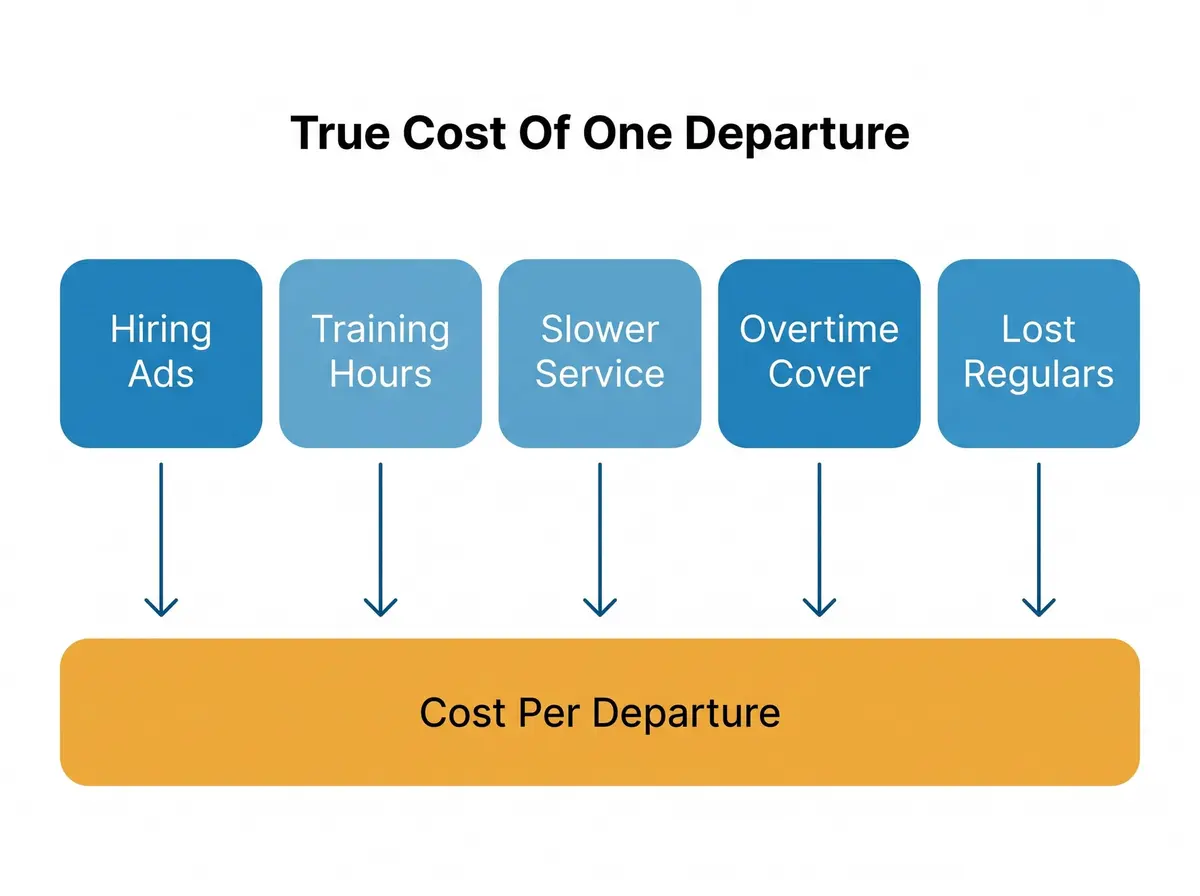
Price those five on your own numbers and the answer for a typical independent restaurant usually lands between $1,500 and $6,000 per hourly departure, and considerably more for a chef or a manager. At 79% turnover across 24 staff, that is a five figure annual line item that never appears on your P&L under its own name. Cutting it is one of the cleanest forms of restaurant cost control available to an operator.
Why is restaurant employee turnover so high?
Exit conversations in hospitality tend to surface the same handful of answers, and pay is rarely first on the list.
The schedule is unpredictable
Posting next week's rota on a Friday night makes it impossible for staff to plan childcare, a second job or a life. Unpredictability, not hours, is what pushes reliable people out. Publishing two weeks ahead and honouring shift preferences costs nothing and is the highest return change most restaurants can make. Our guide to restaurant staff scheduling best practices covers the mechanics.
The first two weeks are chaos
Most restaurant onboarding is a printed menu, a POS password and a shrug. New hires who cannot find the allergen list or ring a modifier correctly feel incompetent in front of guests on day three, and people quit jobs that make them feel stupid faster than they quit jobs that pay badly.
There is nowhere to go
A server who has been excellent for two years and sees no path to trainer, shift lead or supervisor will eventually take that promotion somewhere else. You do not need a corporate ladder. You need one visible next rung.
The tools make the job harder
Handwritten tickets the kitchen misreads, a POS that takes four taps to fire a modifier, stock that runs out mid service with no warning. Every one of these turns a shift into a fight. Staff rarely quit over software, but they absolutely quit over the stress that bad software creates.
How to reduce staff turnover in your restaurant
You do not fix turnover with one grand gesture. You fix it by removing the specific reasons your specific people leave, starting with the ones that cost you least to change.
Fix the schedule first
Publish at least ten days out. Collect availability once a month and actually honour it. Stop scheduling clopens, where someone closes at 1am and opens at 8am, because that pattern burns out your most flexible staff fastest. Consistent scheduling also trims overtime, which is why it appears in every serious guide to cutting labor costs without cutting staff.
Make the first 30 days deliberate
Write a real onboarding plan: a buddy for the first five shifts, a menu test in week one, a fifteen minute check in on day 7, day 14 and day 30. Most turnover happens inside the first 90 days, so front load the effort where the leak actually is. Keeping roles, certifications and shift history in one place with restaurant employee management software means the plan survives a busy week instead of living in your head.
Build one visible rung on the ladder
Name a trainer role and pay it a small premium. Let a strong server run the pre shift briefing once a week. Put a number on what a shift lead earns and what it takes to get there. The point is not the title. The point is that staying becomes a decision with an upside instead of a default.
Take friction off the floor
Every operational fix that makes a shift calmer is also a retention fix. Firing orders straight to a screen with a kitchen management system removes the misread ticket and the argument that follows it. Accurate stock counts mean a server never has to apologise for the third eighty six of the night. Nobody writes this in a resignation letter, but it is why they stay.
We tracked it for a year across our own venues. The month we moved the rota from three days notice to two weeks, voluntary quits dropped by about a third, and we had not changed a single wage. Everyone wants to talk about pay because pay is easy to talk about. Predictability is what people actually leave over.
Zaid Widyan, Founder, Quickbuy
How do you measure whether retention is improving?
Turnover is a lagging number. Look at it once a year and you find out you had a problem about nine months too late. Track these alongside it:
- 90 day retention rate. The share of new hires still with you after three months. This is the number that moves first.
- Average tenure by role. Rising tenure among your cooks is worth more than a flat headline rate.
- Overtime as a share of total labor hours. Spiking overtime is usually a staffing hole, not a busy week.
- Sales per labor hour. A stable, experienced team produces more per hour worked, which makes it one of the restaurant KPIs worth tracking every month.
Pulling labor, sales and shift data into one view with restaurant analytics is what turns these from numbers you calculate once a year into numbers you manage. When you want to know whether your rate is normal for your segment, the National Restaurant Association's workforce research publishes benchmarks worth checking against.
Frequently Asked Questions
What is the average turnover rate in restaurants?
Most markets report restaurant turnover between 70% and 100% a year, with quick service running higher than full service and back of house higher than front of house. Anything under 60% is genuinely good for an independent restaurant. Calculate your own rate before benchmarking, because segment and location move the number a lot.
Why is turnover so high in the restaurant industry?
Unpredictable schedules, thin onboarding, physically demanding shifts and a low perceived cost of switching jobs. Hospitality staff can usually find similar work within a week, so anything that makes a shift unpleasant turns into a resignation faster than it would in another industry.
How much does it cost to replace a restaurant employee?
For an hourly team member, budget $1,500 to $6,000 once you include hiring, training hours, reduced productivity during the ramp up and overtime cover. For a chef or a general manager it runs considerably higher, because the ramp up period is longer and the operational disruption spreads wider.
How can a small restaurant reduce turnover without raising wages?
Publish schedules two weeks ahead, honour availability requests, run a structured 30 day onboarding, and create one paid step up role such as trainer or shift lead. Those four changes cost very little and they address the reasons people actually give when they leave.
Turn a calmer floor into a team that stays
Most of what drives restaurant staff turnover is operational, not financial. Predictable schedules, a real first month, one visible promotion and tools that do not fight your staff will move your rate further than a raise you cannot afford. Quickbuy brings scheduling, roles, orders, kitchen screens and stock into one system, so the friction that wears teams down stops being part of the job. See what that costs on our pricing page, or work out your own turnover bill first and compare the two.