On this page
VAT for restaurants in the UAE is charged at 5% on food and drink, whether the guest eats in, takes away or orders delivery. You must register with the Federal Tax Authority once your taxable supplies pass AED 375,000 over twelve months, and every bill you hand a guest has to stand up as a valid tax invoice.
None of that is hard. What catches operators out is the detail: which of the two invoice types your receipt actually is, what has to be printed on it, and whether your till is producing it correctly a thousand times a day. This guide covers the registration thresholds, the invoice fields the FTA expects, how VAT sits inside a menu price, and what the e-invoicing rollout means for a restaurant. It is general guidance rather than tax advice, so confirm anything borderline with the FTA or your accountant.
Do restaurants charge VAT in the UAE?
Yes. Food and beverage sold by a restaurant is a standard-rated supply at 5%. That covers dine-in, takeaway, drive-through and delivery, and it applies to the food, the drinks and any delivery fee you add. There is no reduced rate for restaurant food, and no eat-in versus take-away distinction like the one some other countries run.
Two things get confused with VAT and should not be. Municipality fees and the tourism or service charges applied in some emirates are separate levies with their own rules, and VAT is generally calculated on the amount including those charges. A discretionary tip the guest chooses to add is not consideration for your supply, so it sits outside VAT.
When does a restaurant have to register for VAT?
Registration is driven by turnover, not by how many covers you do:
- Mandatory at AED 375,000. Once taxable supplies and imports over the previous twelve months exceed AED 375,000, or you expect to exceed it within the next thirty days, you must register.
- Voluntary from AED 187,500. Below the mandatory line but above this one you can register by choice, which lets you recover input VAT on fit-out, equipment and supplies.
- Register within thirty days. Missing that window carries a fixed penalty of AED 10,000.
Both thresholds and the application process live on the Federal Tax Authority's VAT registration page. For one busy venue, AED 375,000 is about AED 31,000 a month, so most established restaurants cross the line well before they think to check.
What must a UAE tax invoice show?
There are two documents, and a restaurant issues both. Which one you owe depends on the value of the supply and whether the customer is VAT registered.
Simplified tax invoice
This is what your ordinary guest receipt is: a supply under AED 10,000 to a customer who is not VAT registered. It has to carry:
- The words "Tax Invoice"
- Your name, address and TRN
- The date of issue
- A description of what was supplied
- The total consideration and the VAT amount charged
Full tax invoice
Required once the supply reaches AED 10,000, or whenever the customer is VAT registered and wants to recover the tax. It adds the buyer's name, address and TRN, a sequential invoice number, unit prices and net amounts, and the VAT rate and amount shown separately.
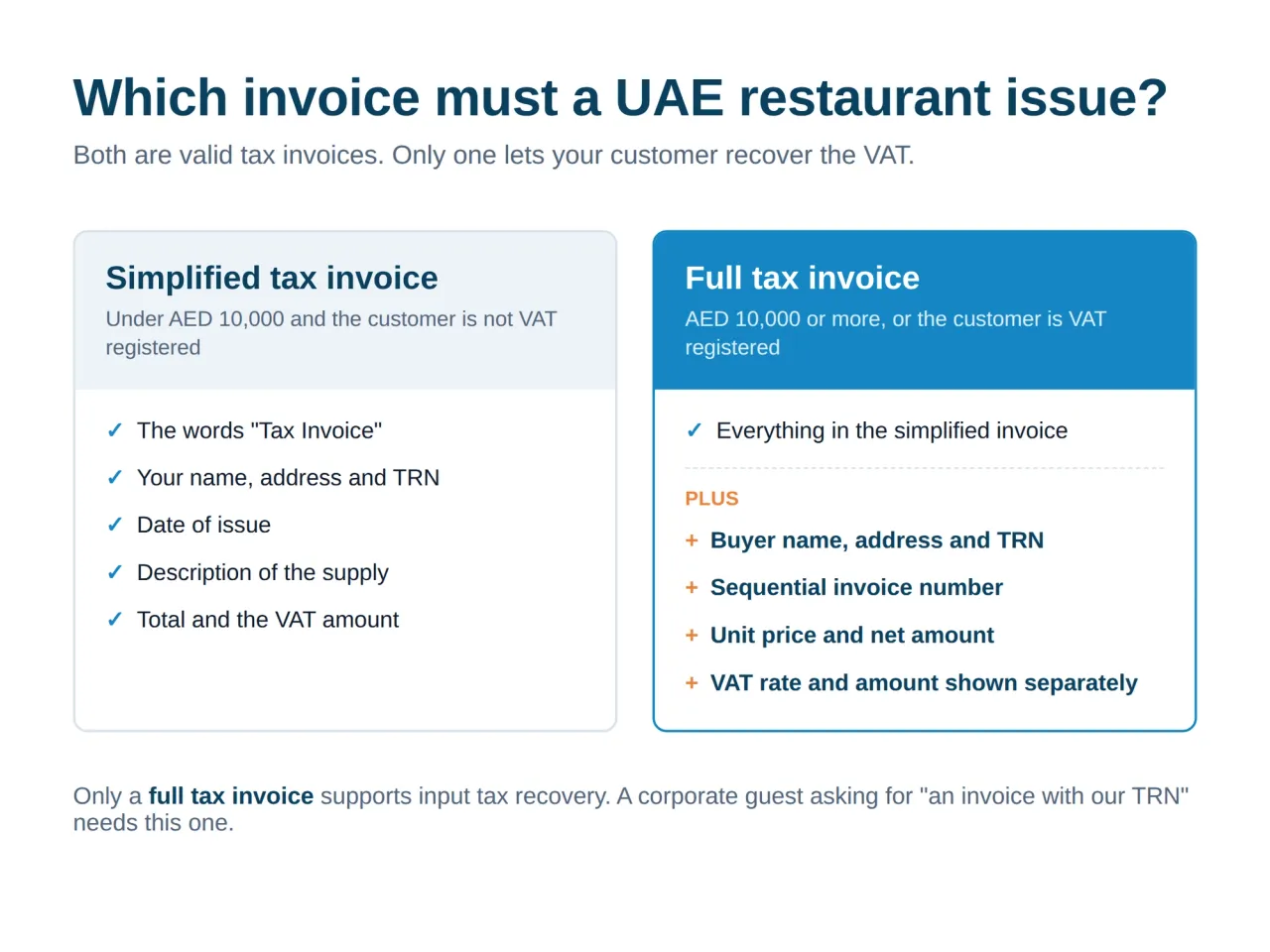
The distinction matters more than it looks. Only a full tax invoice supports input tax recovery, so when a corporate guest pays for a business lunch and asks for a proper invoice with their TRN on it, a simplified receipt genuinely will not do. Getting the format wrong is not free either: under Cabinet Decision 129 of 2025, an incorrect invoice can attract a penalty of AED 2,500 per case from 14 April 2026.
How VAT sits inside a menu price
Consumer prices in the UAE are quoted inclusive of VAT, so the number on your menu is what the guest pays. The tax is already inside your headline price and you are working backwards to find it.
The shortcut: divide the gross amount by 21. A AED 105 bill contains AED 5 of VAT and AED 100 of net revenue. A AED 210 bill contains AED 10. If you have ever wondered why your revenue line looks smaller than your till total, that is where roughly one twenty-first of it went.
This is also why margin maths done on gross sales is wrong. Food cost percentage, prime cost and the rest of your restaurant KPIs should be calculated on net revenue, after VAT comes out. Run them on the gross figure and every ratio flatters you by about 5%, which quietly undermines any cost control work built on top of it.
What your POS has to do about it
Compliance is mostly a POS problem, because the till is what actually prints the document. At minimum it needs to:
- Print your TRN on every receipt. A receipt without it is not a valid tax invoice.
- Issue the right invoice type. Simplified by default, with a way for staff to raise a full tax invoice, capturing the customer's TRN, when a guest asks.
- Show VAT separately. The tax amount has to be visible, not buried inside the total.
- Number invoices sequentially. With no gaps you cannot account for.
- Keep the records. UAE VAT records must be retained for at least five years, which in practice means your reporting has to be exportable rather than trapped in a terminal.
If you are choosing or replacing a till, this belongs on the requirements list from the start rather than being discovered at the first audit. Our comparison of restaurant POS systems covers how to evaluate one, and Quickbuy's restaurant POS software issues both invoice types and keeps the VAT breakdown on every ticket.
Filing is the other half of it. A quarterly return is far less painful when your restaurant reporting already splits net revenue, VAT collected and input VAT by period, instead of being reconstructed from Z-reports the week it falls due.
The mistake I see most often is not evasion, it is a POS configured once at opening and never checked again. We found a venue printing simplified receipts to corporate accounts for eight months. Nobody was cheating, but their clients could not recover a dirham of input tax, and unpicking it afterwards took an accountant three days.
What does e-invoicing mean for restaurants?
The UAE is moving to structured e-invoicing in phases. Invoices in scope must be issued as PINT AE compliant XML and passed through an Accredited Service Provider, rather than emailed as a PDF.
The announced timeline runs roughly like this: a voluntary pilot from 1 July 2026, businesses with revenue of AED 50 million or more appointing a provider by 31 October 2026 and going live on 1 January 2027, and those below that threshold appointing by 31 March 2027 and going live on 1 July 2027 (KPMG summary of the framework).
The part that matters for most restaurants: the mandate covers business to business and business to government invoices, not ordinary consumer receipts. Dine-in and delivery tickets are not in the first waves. Corporate catering, event invoicing and any account customer you bill are. If that is a meaningful share of your revenue, the practical step this year is confirming your POS or accounting stack has a route to an Accredited Service Provider, not rebuilding anything yet.
Frequently Asked Questions
Do restaurants charge VAT in the UAE?
Yes, at the standard 5% rate, on dine-in, takeaway and delivery alike. It applies to food, drinks and delivery charges. VAT registered restaurants must show the tax on the bill and account for it in their returns.
What must a tax invoice show?
A simplified tax invoice needs the words "Tax Invoice", your name, address and TRN, the date, a description of what was supplied, and the total with the VAT amount shown. A full tax invoice adds the buyer's name, address and TRN, a sequential number, net amounts, and the VAT rate and amount shown separately.
Is a normal restaurant receipt a valid tax invoice?
It is, provided it carries the required fields, above all your TRN and a visible VAT amount. A till slip showing only a total is not compliant. For supplies of AED 10,000 or more, or for a VAT registered customer who wants to recover the tax, you need a full tax invoice instead.
How do I work out the VAT inside a VAT inclusive price?
Divide the gross amount by 21. On a AED 168 bill the VAT is AED 8 and net revenue is AED 160. Multiplying the gross by 5% overstates the tax, because the 5% applies to the net figure rather than the total the guest paid.
Do I need to register if I turn over less than AED 375,000?
Not mandatorily. Above AED 187,500 you may register voluntarily, which is often worth it in a fit-out year when input VAT on equipment and construction is recoverable. Below that you cannot register, and you should not be charging VAT.
Spend less of your week on the paperwork
Quickbuy prints a compliant tax invoice on every ticket, raises full tax invoices with a customer TRN when a guest asks, and keeps net revenue, VAT and input tax split in reporting you can hand straight to your accountant. See Quickbuy pricing or talk to us about what your current till is not capturing.