On this page
- What is restaurant average order value?
- Why average order value beats chasing more covers
- The four levers that move restaurant average order value
- How to raise average order value on digital orders
- Menu changes that lift the average without discounting
- How to measure it without fooling yourself
- Frequently Asked Questions
- Where Quickbuy fits
Restaurant average order value is the average amount a guest spends per order: total revenue divided by the number of orders. It is the cheapest growth lever most restaurants own, because moving it costs nothing in rent, nothing in ad spend, and not one extra cover.
Published benchmarks are close to useless here. A shawarma counter in Deira and a steakhouse in DIFC are both restaurants, and neither number tells you anything about the other. The only comparison worth making is your own figure this month against last month, split by channel and by daypart. If you already watch the restaurant KPIs that actually matter, this is the one that responds fastest once you work on it deliberately.
What is restaurant average order value?
Average order value, usually shortened to AOV, answers one question: when someone orders from you, how much do they spend? It is a per-order number, not a per-guest number, and that distinction matters more than people expect.
The formula
Take a period, take the revenue, take the order count, divide:
- Pick the window: a week is long enough to smooth out a quiet Tuesday, short enough to react to.
- Total the net revenue for that window, excluding VAT and excluding delivery fees you collect on someone else's behalf.
- Count the completed orders, not the covers and not the items.
- Divide revenue by orders. That is your AOV.
Do it separately for dine-in, pickup and each delivery app. A blended figure hides the thing you need to see, which is that the same menu earns wildly different amounts depending on how the order was placed.
How it differs from average check
Average check is usually calculated per cover, so a table of four splitting one order shows up very differently in the two numbers. Neither is wrong. Just pick one, define it once, and make sure everyone in the business is quoting the same one, because two managers arguing from two definitions is a waste of a meeting.
Why average order value beats chasing more covers
Ten percent more covers means more staff on the floor, more prep, more pressure on the pass, and usually more marketing spend to fill the seats. Ten percent more average order value means the same guests, the same shifts, the same kitchen, and a bigger number at the end of the night. One of those is expensive to buy and the other is mostly a design problem.
Run the arithmetic on your own numbers before you believe it. A site doing 120 orders a day at AED 85 turns over AED 10,200. Push the average to AED 94, which is one extra side on roughly one order in three, and you clear AED 11,280. That is AED 32,400 a year of incremental revenue from a change that adds no headcount. For wider industry context on where restaurant traffic and spend are heading, the National Restaurant Association publishes an annual State of the Restaurant Industry report worth reading once a year.
The four levers that move restaurant average order value
Almost everything that works reduces to four levers. Any tactic you read about is one of these wearing a different hat, which is useful, because it means you can stop collecting tactics and start deciding which lever is loosest in your operation.
Attach rate
The share of orders that include a second item: a side, a drink, a dessert. This is usually the loosest lever in a restaurant that has never worked on it, and the easiest to measure. Pull last month's orders and count how many contained exactly one item. In a lot of delivery-heavy sites that figure is above 40 percent, and every one of those is a guest who was never actually asked.
Modifier depth
Size upgrades, extra protein, premium swaps, add a sauce. Modifiers are pure margin when they are priced properly, because the labour and the packaging are already committed. The failure mode is burying them: if a guest has to tap three times to find the large size, most will not.
Menu position
What a guest sees first has an outsized effect on what they buy. On a printed menu that is the top right of the page. On a phone it is the first screen, before any scrolling, which is a much smaller piece of real estate than most restaurants design for.
When you ask
Timing beats wording. An add-on offered at the moment the guest picks the item converts far better than the same offer at checkout, when the guest has mentally finished and moved on to paying. This is the single most common mistake in digital ordering flows: everything gets deferred to a last-screen upsell that reads as a toll booth.
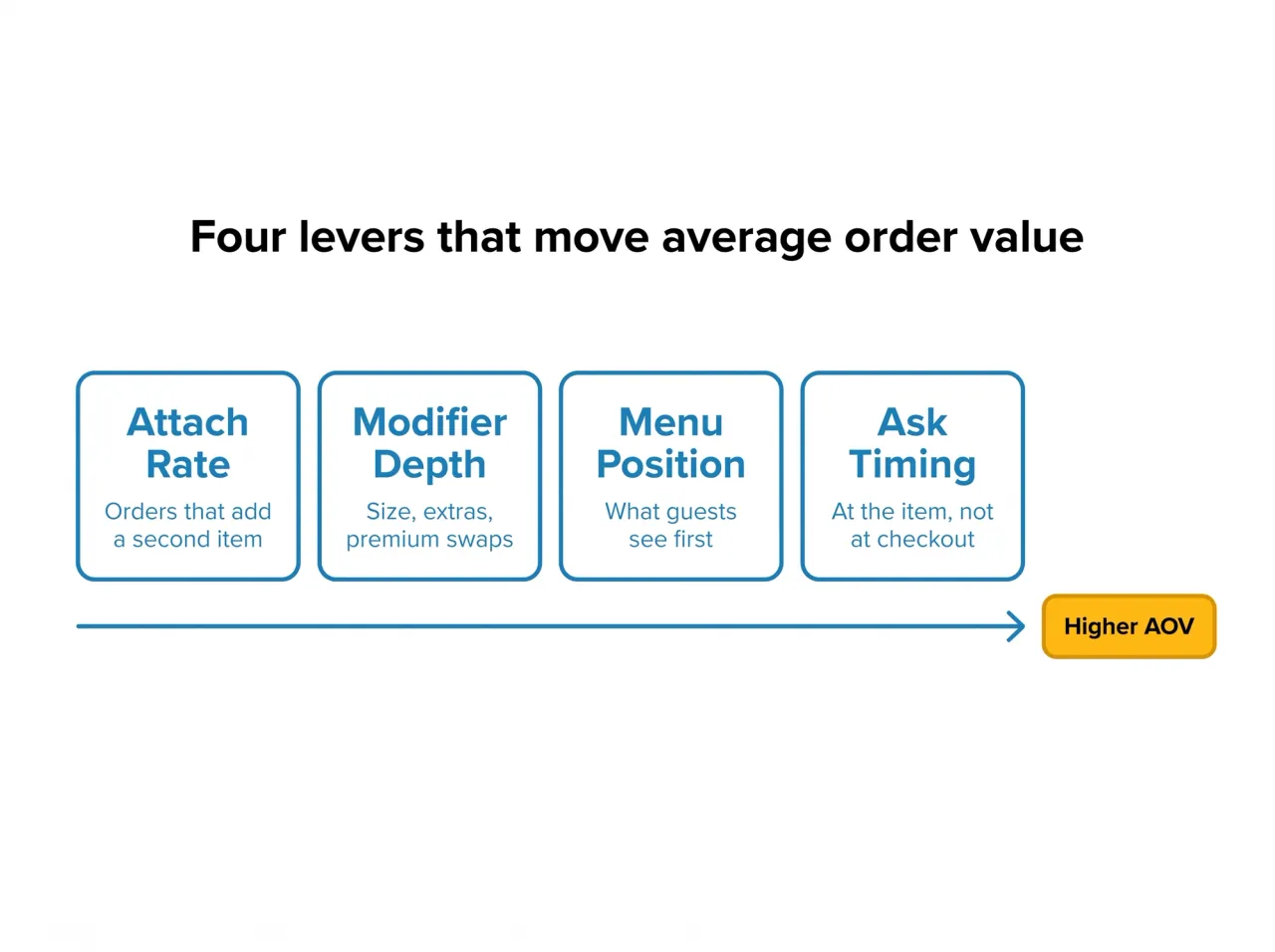
We tested this on our own pilot sites before we shipped it. Moving the drink prompt from the checkout screen to the moment the guest adds a main lifted attach rate by about a third. Same drinks, same prices, same menu. The only thing that changed was when we asked.
How to raise average order value on digital orders
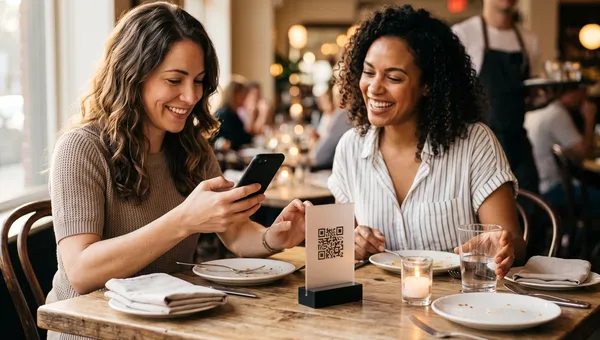
Digital ordering is where the biggest gains sit, because a screen never forgets to ask, never gets busy, and never decides a table looks like it is in a hurry. A well-built QR code ordering flow can put the right prompt in front of every guest, every time, without a single extra word from your staff.
The mechanics live in how the menu is structured, not in the offer itself. Getting your digital menu organised properly is most of the work: sensible categories, modifiers attached to the items they belong to, and the high-margin items where thumbs actually land.
- Attach the prompt to the item, not to the cart. Adding a burger should offer the side, right there.
- Cap it at one prompt per item. Two feels like a shakedown and guests start dismissing everything.
- Default to the size you want to sell, and let the guest step down rather than up.
- Show the price of the upgrade, not the total. The delta reads as small, the total reads as expensive.
- Put combos above singles. If a meal deal is genuinely better value, it should not be buried under the item it replaces.
Menu changes that lift the average without discounting
Discounting raises order count and lowers order value, which is the exact opposite of what you want here. The alternative is straightforward menu work: fix the anchor pricing, make the profitable items easy to find, and cut the items nobody orders so the ones that pay for the kitchen have room to breathe. Menu engineering is the discipline for this and it pays back faster than almost anything else on this list.
- Add one item priced above your current top item. It rarely sells much, and it makes the item below it look reasonable.
- Kill the bottom decile. Items that sell fewer than a handful a week cost you prep, stock and menu space.
- Name the upgrade, do not number it. "Add grilled halloumi" beats "+ AED 12".
- Photograph the high-margin items and nothing else. Photos pull the eye, so spend them where the margin is.
How to measure it without fooling yourself
The trap is averaging across everything and congratulating yourself when a good week of dine-in masks a collapsing delivery channel. Segment before you celebrate. Your restaurant reporting should let you see AOV by channel, by daypart and by day of week, because those three cuts explain most of the movement you will ever see.
- Set a baseline over four full weeks before you change anything, so seasonality does not get credited to your work.
- Change one lever at a time and hold it for two weeks. Changing three things at once means learning nothing.
- Watch order count alongside AOV. If the average climbs while orders fall, you have not upsold anyone, you have priced someone out.
- Check the refund and complaint rate too. An aggressive upsell that lifts AOV and annoys regulars is a loan against next quarter.
Frequently Asked Questions
What is a good average order value for a restaurant?
There is no universal figure worth quoting, because format, city and channel swamp any industry average. Quick service, casual dining and fine dining are not comparable, and delivery orders usually run higher than dine-in because they are placed for more than one person. Set your own baseline over four weeks and target a 5 to 10 percent lift from it.
How do you calculate average order value?
Divide total net revenue by the number of completed orders for the same period. Exclude VAT and any delivery fees collected on behalf of a third party, and count orders rather than covers or items. Calculate it separately for each channel, because a blended number hides more than it tells you.
Does upselling annoy customers?
Badly timed upselling does. One relevant prompt attached to the item a guest just chose reads as helpful. Three prompts stacked on the checkout screen read as a toll booth, and guests learn to dismiss all of them, including the useful one. Relevance and timing decide how it lands, not whether you ask at all.
Is it better to increase average order value or order frequency?
Average order value first, because it is faster and cheaper to move. Frequency needs a reason for the guest to come back, which usually means a loyalty mechanic and a few months of patience. Order value needs a menu change you can ship this week. Do both eventually, in that order.
Where Quickbuy fits
Quickbuy is built so the prompts sit where they work: modifiers attached to items, combos surfaced above singles, and upgrades priced as a visible delta rather than a scary total. It reports AOV by channel and daypart out of the box, so you can tell whether a change actually moved anything. Once the average is where you want it, a restaurant loyalty program is the natural next lever, because frequency compounds on top of a healthy order value rather than propping up a weak one.
If you want to see what that looks like on your own menu, our pricing is public and there is no setup fee to work around.