On this page
- What does restaurant bookkeeping involve?
- What records does a UAE restaurant have to keep?
- Corporate Tax: what changes for restaurants?
- A restaurant bookkeeping routine: daily, weekly, monthly
- What should restaurant accounting software do?
- Common restaurant bookkeeping mistakes
- Frequently Asked Questions
- Keep the books as you trade
Restaurant bookkeeping means recording every sale, supplier bill, expense and bank movement, with the VAT on each, so you can close each month, prepare your VAT return and work out Corporate Tax from real numbers. In the UAE those records have to be kept for seven years, and the easiest way to keep them is to let your POS post sales into the books instead of copying totals from the till.
Most restaurant owners didn't open a restaurant to do accounts, and it shows: books get updated once a quarter, the day before the VAT return is due. That used to be survivable. With Corporate Tax in place and the small-business relief window closing under the current rules, it's a risk. This guide covers what restaurant bookkeeping involves, which records a UAE restaurant has to keep, what Corporate Tax changes, a daily to monthly routine, and what accounting software should do for you. It's practical guidance, not tax advice, so confirm your own position with a registered tax agent.
What does restaurant bookkeeping involve?
Five streams of money need to be in the books, each with its VAT:
- Sales: every day's takings, split by payment method (card, cash, wallet and delivery apps), with the output VAT you collected.
- Cost of goods: what the food and drink you sold actually cost, ideally from recipe costs rather than a guess at month end.
- Supplier bills: every invoice, matched to what was delivered, with the input VAT you can reclaim.
- Operating expenses: rent, utilities, staff costs, licences, marketing and repairs.
- Bank and card settlements: what actually landed in the bank, which is not the same as what you sold once card fees and refunds come out.
Get those five right every month and the rest of accounting, the P&L, the balance sheet, the tax returns, is mostly arithmetic.
What records does a UAE restaurant have to keep?
Keep everything that supports your sales, costs and tax figures: daily sales reports, tax invoices you issue and receive, supplier delivery notes, expense receipts, bank statements and card settlement reports. The Corporate Tax Law requires businesses to keep records for seven years after the end of the tax period they relate to, so for most restaurant records the simple rule is to keep everything for seven years, which also covers what you need for VAT.
Records don't need to be on paper. What matters is that they're complete, readable and easy to produce if the Federal Tax Authority asks. A system that stores the sale, the invoice and the supporting document together beats a shoebox of receipts, and our UAE restaurant VAT guide explains what your invoices themselves need to show.
Corporate Tax: what changes for restaurants?
The rate
Corporate Tax applies at 0% on taxable income up to AED 375,000 and 9% above it. Taxable income starts from your accounting profit, which is why the books matter: you can't work out what you owe from a bank balance.
Small Business Relief has an end date
Businesses with revenue of AED 3 million or less can elect Small Business Relief and be treated as having no taxable income for that period. Under the Ministry of Finance decision, the relief only applies to tax periods ending on or before 31 December 2026. AED 3 million a year is about AED 250,000 a month, so plenty of busy single-site restaurants are already above it. If the relief isn't extended, restaurants that relied on it will need to work out taxable income from proper accounts for 2027.
What you need for the return
Your tax agent will want a profit and loss statement, a balance sheet and the ledger behind them, for the whole year. If you're registering a new business, our checklist for opening a restaurant in the UAE covers when the tax registrations fit into the opening timeline.
A restaurant bookkeeping routine: daily, weekly, monthly
Books stay accurate when they're updated in small steps, not in one painful catch-up.
- Daily: close the till, check sales by payment method against the card machine report and the cash count, and note refunds and voids.
- Weekly: enter supplier bills against the deliveries you actually received, and record expenses with their receipts.
- Monthly: match the bank statement to the books, review the VAT you collected and paid, check the P&L for anything odd, then close the month so nobody changes it afterwards.
- Quarterly or as your tax period requires: prepare the VAT return from the reviewed months.
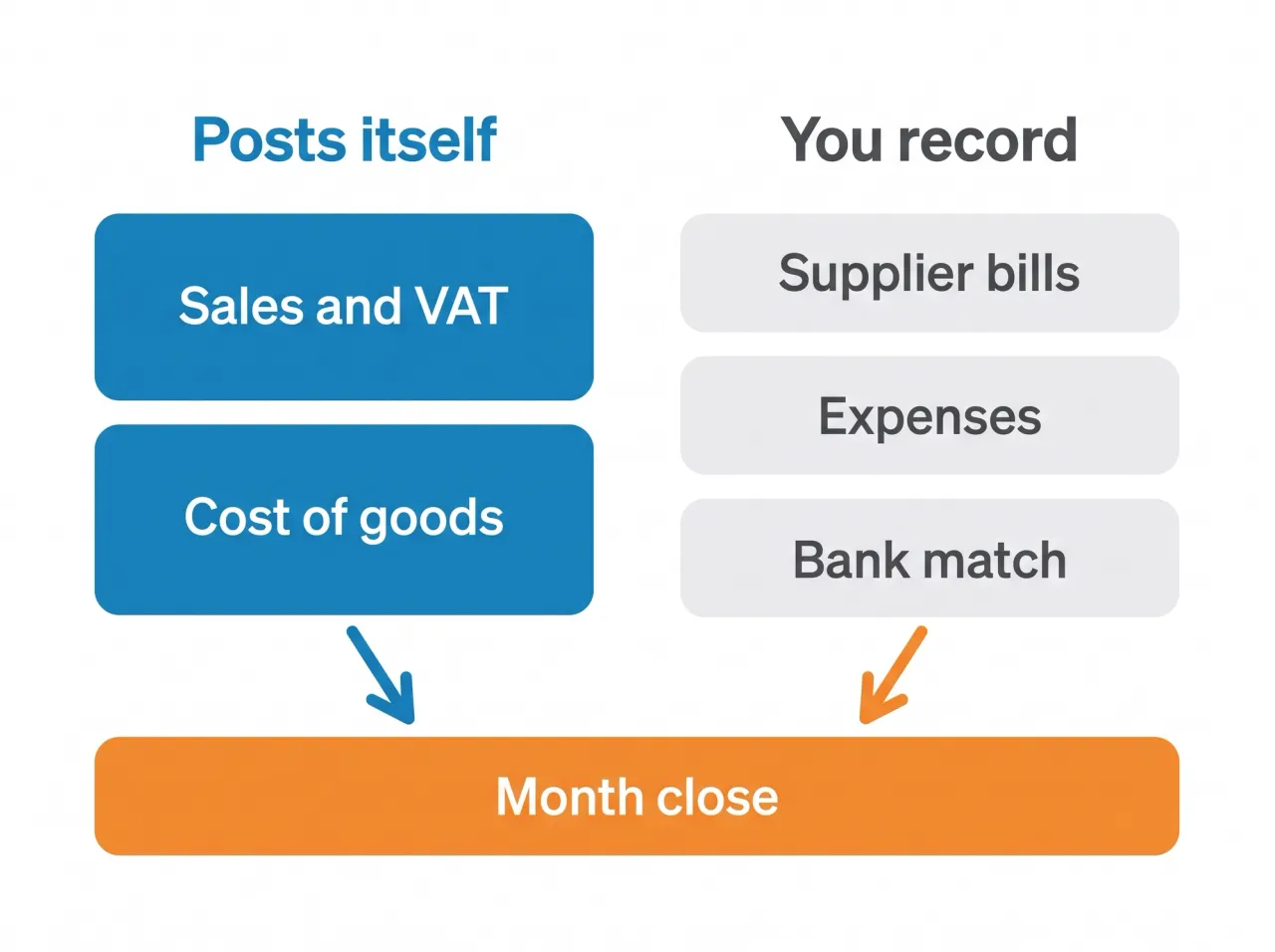
The month-end review is also where the numbers start working for you. Once the P&L is reliable, you can track prime cost and break-even every month, which our guide to restaurant KPIs walks through.
What should restaurant accounting software do?
Generic accounting packages can keep restaurant books, but someone still has to type the sales in. Look for software that removes that step:
- Sales and VAT posted from the POS automatically, order by order.
- Cost of goods posted from recipe costs, so food cost shows in the P&L as you trade.
- Supplier bills recorded against purchase orders and deliveries.
- A VAT summary and return figures built from the same ledger.
- A profit and loss statement and balance sheet without exporting to spreadsheets.
- Approval for manual journal entries, and a month-end close that locks the period.
That's the gap restaurant accounting software built into your operations closes. In Quickbuy, sales and their VAT post to the ledger when an order is settled, and cost of goods posts from your recipe costs, so the profit and loss fills in as you trade. Supplier bills and customer invoices live in the same books, journal entries go through an approval step, and closing a month locks it so entries can't be changed after review. The VAT section prepares your summary and return figures, and the P&L and balance sheet sit in the same system your accountant can work from.
We made sales post to the ledger automatically because copying totals from the till into a spreadsheet is where most restaurant books go wrong: a missed day, a refund counted twice, VAT typed from memory. The catch is that automation is only as good as what feeds it. If your recipe costs are wrong, cost of goods is wrong on every single order. So when a restaurant moves its books into Quickbuy, the first job isn't the chart of accounts. It's getting the recipes right.
If your sales still live in one system and your books in another, start with the POS. Restaurant POS software that already posts to the ledger removes the daily copy job entirely, and restaurant analytics built on the same data means the sales dashboard and the P&L start from the same numbers.
Common restaurant bookkeeping mistakes
- Recording card payouts as sales. The bank receives sales minus fees, so booking the payout understates revenue and hides what card fees cost you.
- Treating VAT collected as income. It belongs to the FTA from the moment you charge it.
- Paying supplier invoices without checking them against deliveries, which our guide to restaurant purchasing software covers in detail.
- Mixing personal and business spending on the same card.
- Never closing a month, so last quarter's numbers keep changing.
Frequently Asked Questions
What is restaurant bookkeeping?
It's the day-to-day recording of a restaurant's sales, cost of goods, supplier bills, expenses and bank movements, with the VAT on each. Good bookkeeping is what lets you close each month, prepare VAT returns and work out Corporate Tax from accurate figures.
How long do restaurants in the UAE have to keep financial records?
The Corporate Tax Law requires records to be kept for seven years after the end of the tax period they relate to. Keeping all sales, purchase, expense and bank records for seven years is the simplest way to stay covered for both Corporate Tax and VAT.
Do restaurants in the UAE pay Corporate Tax?
Yes, restaurant businesses are within Corporate Tax: 0% on taxable income up to AED 375,000 and 9% above it. Businesses with revenue of AED 3 million or less can elect Small Business Relief for tax periods ending on or before 31 December 2026 under the current decision. Confirm your position with a registered tax agent.
Can I do restaurant bookkeeping myself?
Yes, if your systems do the heavy lifting. When sales, VAT and cost of goods post automatically, the owner's job shrinks to entering bills, checking the month and closing it. Most restaurants still use an accountant or tax agent for the returns and year-end.
What is the difference between bookkeeping and accounting for a restaurant?
Bookkeeping is recording the transactions accurately every day. Accounting is what you do with them: preparing the P&L and balance sheet, reviewing performance and filing tax returns. Accounting is only as reliable as the bookkeeping underneath it.
What software do restaurants use for bookkeeping?
Many use a generic accounting package and type in daily sales from the POS. Restaurant-specific systems post sales, VAT and cost of goods from the POS directly, which removes the manual step where most errors happen.
Keep the books as you trade
Restaurant bookkeeping gets easy when it stops being a separate job. Let the POS post sales, VAT and cost of goods, spend your time on bills and the month-end review, keep every record for seven years, and close each month properly before the next one starts.
Quickbuy keeps your POS, stock and books in one system, so sales, VAT and cost of goods reach the ledger without anyone retyping them. Compare Quickbuy plans and pricing, or book a demo and see a month close on your own data.