Most restaurant menus are designed around tradition, the chef's pride, or whatever fits neatly on the page. Very few are designed around profit - and that gap is exactly where menu engineering comes in. It is one of the fastest, lowest-cost ways to grow your margins without raising every price or cutting quality.
Menu engineering is the practice of analyzing every dish by two numbers - how profitable it is and how often it sells - and then redesigning your menu to guide guests toward the items that make you the most money. Done well, it can lift profit per guest by 10-15% without a single extra customer walking through the door.
What Is Menu Engineering?
Menu engineering combines two disciplines: cost accounting and menu psychology. The accounting side tells you the contribution margin of each dish - its selling price minus its food cost. The psychology side controls what guests actually notice and order, through layout, descriptions, and pricing. When you align the two, your highest-margin dishes also become your best-sellers.
The goal is not to charge more for everything. It is to know which items deserve the spotlight, which need to be reworked, and which are quietly dragging your profit down - and then to act on each one deliberately.
The Menu Engineering Matrix: 4 Types of Dishes
When you plot profitability against popularity, every item on your menu falls into one of four categories. Classifying your dishes this way is the foundation of the whole process.
Stars - High Profit, High Popularity
Stars are your champions: guests love them and they make you good money. Protect them. Feature them prominently, keep their quality consistent, and resist the urge to discount them. Your menu should be built around these dishes.
Plowhorses - Low Profit, High Popularity
Plowhorses sell well but earn little. They are popular for a reason, so you rarely remove them - instead you re-engineer their margin: trim the portion slightly, renegotiate ingredient costs, pair them with high-margin sides, or nudge the price up modestly. A small gain on a high-volume item adds up fast.
Puzzles - High Profit, Low Popularity
Puzzles are profitable but overlooked. The fix is usually visibility, not the dish itself: give it a more appetizing description, move it to a high-attention spot, add a photo, or have staff recommend it. If it still does not sell after better placement, it may not belong on the menu.
Dogs - Low Profit, Low Popularity
Dogs neither sell nor earn. Unless a dish serves a strategic purpose - a vegan option, a signature loss-leader - it is a candidate for removal. Every dog you cut simplifies your kitchen, reduces waste, and frees up space to promote your stars and puzzles.
How to Engineer Your Menu in 6 Steps
Here is the practical workflow for applying menu engineering in your own restaurant.
- Calculate the food cost and contribution margin of every item. You cannot engineer what you have not measured.
- Pull your sales mix - how many times each item sold over the last 30 to 90 days. That is your popularity score.
- Plot every dish on the matrix as a star, plowhorse, puzzle, or dog.
- Take quadrant-specific action: feature stars, re-engineer plowhorses, reposition puzzles, and cut dogs.
- Redesign the layout and descriptions so the most profitable items get the most attention.
- Re-measure every 60 to 90 days. Menu engineering is a cycle, not a one-time project.
Menu Design Psychology That Increases Spend
Once you know which items to promote, design decides whether guests actually order them. These proven tactics quietly raise average order value:
- Use the prime real estate. Eyes tend to land on the top-right of a page and on the first and last items in a list - put your stars there.
- Drop the currency symbols. Menus that show “18” instead of “$18.00” consistently see higher spend, because the symbol triggers the pain of paying.
- Write sensory, descriptive names. “Slow-braised short rib” outsells “beef stew” - vivid wording raises both orders and perceived value.
- Anchor with a premium item. One high-priced dish makes everything near it look reasonable by comparison.
- Limit the choices. Too many options cause decision paralysis; tighter menus sell more and waste less.
- Use highlights sparingly. Boxes, icons, and “chef's pick” tags draw the eye - but only when used on a few items, not everywhere.
Your Digital Menu Is Your Best Test Lab
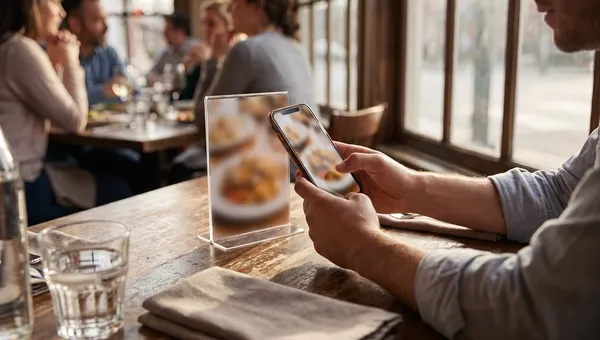
Printed menus are expensive and slow to change, which is why most restaurants only redo them once or twice a year. A digital menu removes that friction. With Quickbuy's QR and online ordering menu, every change is instant and every order becomes data.
That turns your menu into a live experiment. You can reorder items so stars appear first, add photos to your puzzles (dishes with images are ordered far more often), test a price change overnight, and surface high-margin add-ons and upsells right at checkout. Best of all, Quickbuy records your real sales mix automatically - so the popularity half of menu engineering is handled for you.
Common Menu Engineering Mistakes to Avoid
- Pricing on food cost alone. Cost-plus pricing ignores popularity and demand - the two things that actually drive profit.
- Listing too many items. A bloated menu raises food costs, slows the kitchen, and overwhelms guests.
- Discounting your stars. Never cut the price of a dish that already sells well and earns well.
- Forgetting photos. On digital and delivery menus, items without images are routinely skipped.
- Doing it once and stopping. Costs, seasons, and tastes change; an un-revisited menu drifts out of date within months.
Frequently Asked Questions
How often should I redo menu engineering?
Review your sales mix and margins every 60 to 90 days, and run a deeper redesign whenever your food costs shift significantly or you launch a seasonal menu.
How many items should a restaurant menu have?
There is no universal number, but most high-performing menus are tighter than owners expect - often around seven items per category. Fewer, well-executed dishes usually outperform a sprawling menu.
Does menu engineering work for online and delivery menus?
Yes - arguably better. Digital menus give you instant data, easy reordering, and photos, all of which make the engineering cycle faster and more precise than print ever allowed.
Turn Your Menu Into a Profit Engine
Menu engineering is one of the rare growth levers that costs almost nothing and compounds with every service. Start by classifying your dishes, redesign around your stars, and let your digital menu do the measuring. With Quickbuy, you get the sales data, instant menu control, and upsell tools to turn every order into a slightly more profitable one - month after month.