On this page
- Do you need a special licence for a cloud kitchen in Dubai?
- What permits does a cloud kitchen in Dubai need?
- How much does a cloud kitchen cost in Dubai?
- Shared cloud kitchen or your own unit?
- How do you make a cloud kitchen profitable?
- Where Quickbuy fits a cloud kitchen
- Frequently Asked Questions
- Cost the menu before you sign
A cloud kitchen in Dubai needs the same approvals as a restaurant, minus the dining room: a Dubai trade licence with a food activity, a Dubai Municipality food permit for the kitchen, and Civil Defence approval. Most new operators start in a shared cloud kitchen facility, where setup consultants quote roughly AED 5,000 to 15,000 a month for a unit, with much of the building's approval work already done.
The rent rarely decides whether it works. The delivery apps take a cut of nearly every order, and that cut plus packaging has to fit inside your menu prices. This guide covers the licence and permits for a cloud kitchen in Dubai, what rent and setup cost, shared units versus your own, and how to make the numbers work.
Do you need a special licence for a cloud kitchen in Dubai?
No. There's no separate cloud kitchen licence. You trade under a mainland Dubai trade licence that includes a food activity, usually a restaurant or food preparation activity without dine-in. Confirm the exact activity with the Department of Economy and Tourism when you apply, because it decides what the municipality will approve. A general trading licence doesn't cover cooking food. Setup consultants generally say the trade licence takes days and the municipality approvals take a few weeks, so plan the lease around that.
Free zone licences are a grey area for a kitchen that sells across Dubai, so check before you sign a lease. If you're starting from zero, our guide to the cloud kitchen business model explains how the model works before you get into Dubai specifics.
What permits does a cloud kitchen in Dubai need?
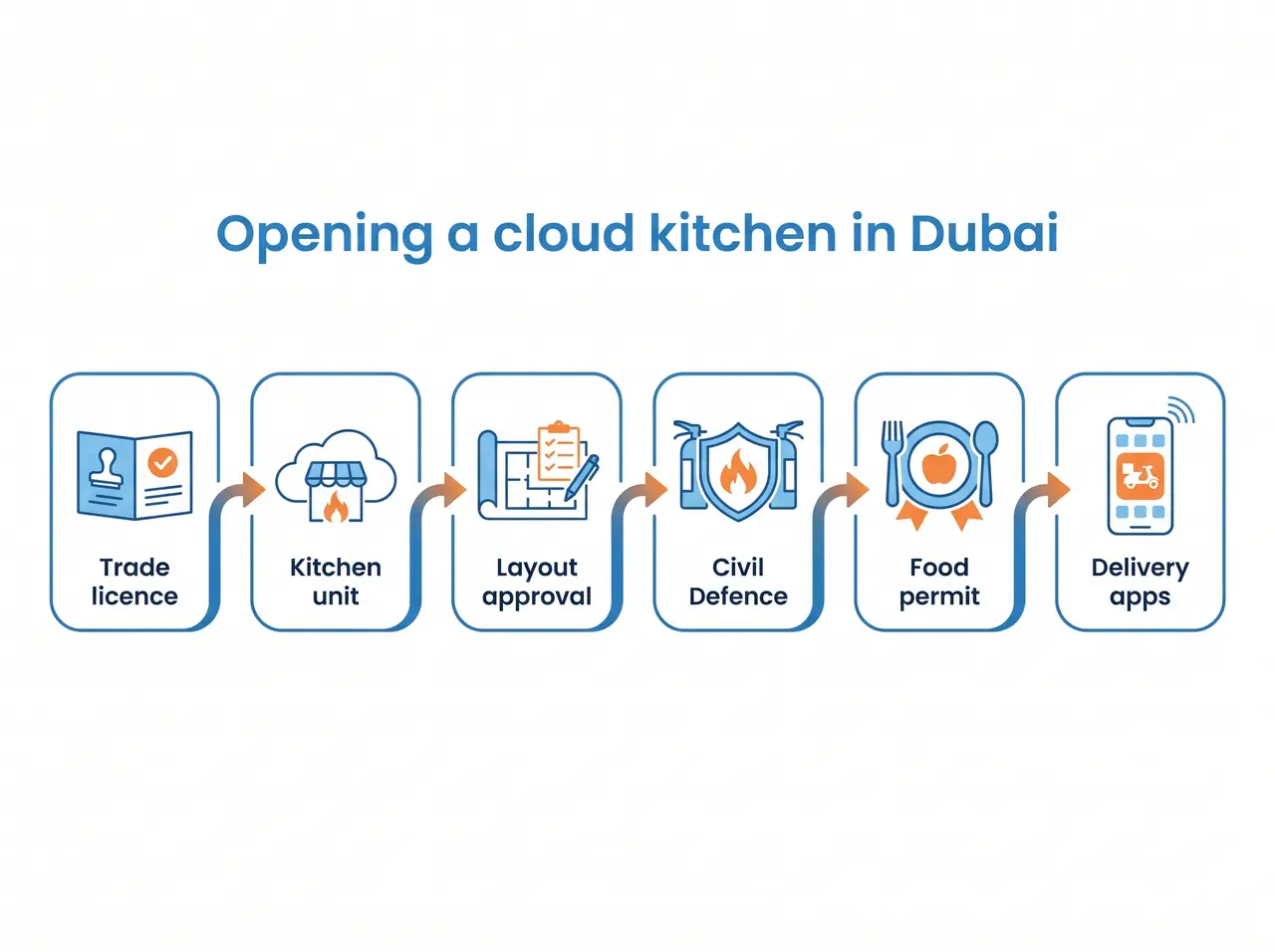
Plan for these approvals, roughly in this order:
- A Dubai Municipality food establishment approval, which starts with your kitchen layout drawings
- Registration on the municipality's food safety system, with a certified person in charge for the kitchen
- Civil Defence approval for gas, extraction and fire safety
- A registered lease (Ejari) if you rent your own unit; in a shared facility the operator usually holds the tenancy
- Health cards and food safety training for everyone who handles food
The layout carries the most weight. Dubai's Food Code expects food to move one way, from receiving to storage, preparation, cooking and dispatch, with a handwash station in every preparation area. Shared facilities sell units built to pass that check, and it's a big part of what you pay for.
How much does a cloud kitchen cost in Dubai?
Costs split into one-off setup and monthly running costs. Setup consultants put the trade licence and food permits at roughly AED 13,000 to 25,000 for a mainland setup, before rent and equipment. Treat every figure here as a starting estimate and get written quotes.
Rent
Shared cloud kitchen units in industrial areas such as Al Quoz are commonly quoted at around AED 5,000 to 15,000 a month, often including basic utilities, shared cold storage and a loading area. A dedicated unit costs more, and its fit-out, approvals and Ejari are then yours to arrange. Ask every provider for a quote that separates rent, utilities and service charges. Check what the rent leaves out, because some providers charge separately for gas, cold storage, cleaning or extra hours.
Fit-out and equipment
In a shared facility you may only add your own cooking line and small equipment. In your own unit you also pay for extraction, gas, cold rooms and the layout the municipality approves, which is usually the largest one-off cost.
Commission and packaging
Nearly every order arrives through a delivery app, so commission is your biggest running cost after food and rent. Our comparison of delivery apps for UAE restaurants covers what each app charges and what to ask before you sign. Packaging matters more than in a restaurant too, because every single order leaves in it. If you can, keep one channel you own, such as pickup orders, so not every sale pays commission.
Shared cloud kitchen or your own unit?
A shared facility is faster and cheaper to start. The building, approvals, cold storage and loading bay are already there, and you can test a concept for a few months before committing. Your own unit costs more up front but gives you control of the layout, the hours and room to grow. Many operators start shared and move once the orders justify it. Before you sign with a shared facility, ask how many kitchens share the loading bay and cold storage, how rider pickups are handled at peak times, and how much notice you need to give to leave.
Rent is the number everyone asks about, but commission is the one that decides it. If a dish can't carry the app's cut and its packaging, it doesn't belong on a cloud kitchen menu.
How do you make a cloud kitchen profitable?
Delivery-only kitchens live or die on the economics of each order. These habits make the difference:
- Cost every dish with commission and packaging included, not just ingredients
- Keep the menu short, so prep and stock stay simple
- Price the delivery menu to carry the commission instead of absorbing it
- Log waste daily, because unsold prep is the quiet cost of a delivery-only kitchen
- Order from suppliers against what you sold, not against habit
Our guide to food cost percentage shows how to set a target for each dish before you add the delivery costs on top. Then check each dish again at the delivery price you'll actually charge, with commission and packaging taken off.
Where Quickbuy fits a cloud kitchen
Quickbuy doesn't take delivery-app orders today, so it won't replace the app tablets in a delivery-only kitchen. Where it fits is behind the line. Each dish shows its recipe cost based on what you actually paid suppliers, purchase orders go out by email and deliveries are checked in against them, and supplier bills, VAT and the P&L sit in the same place.
It suits a kitchen that also takes its own pickup orders best: guests order by QR code, and each order draws down ingredient stock automatically, oldest first.
Frequently Asked Questions
What are the requirements to open a cloud kitchen in Dubai?
A Dubai trade licence with a food activity, a Dubai Municipality food permit that starts with layout approval, registration on the municipality's food safety system with a certified person in charge, and Civil Defence approval. If you rent your own unit, you also need a registered lease (Ejari).
How much does a cloud kitchen cost in Dubai?
Setup consultants quote roughly AED 13,000 to 25,000 for the licence and permits, and around AED 5,000 to 15,000 a month for a unit in a shared facility. Your own unit, fit-out, equipment, commission and packaging come on top, so get written quotes before you plan.
Can you run a cloud kitchen from home in Dubai?
Not as a normal delivery kitchen. A cloud kitchen needs a commercial unit that passes the municipality's layout check and Civil Defence approval, which a home kitchen won't. Dubai has separate licences for some home-based businesses, so check with the Department of Economy and Tourism whether yours qualifies.
Do you need your own Ejari for a cloud kitchen?
If you rent your own unit, yes, because the approvals are tied to a registered lease. In a shared facility the operator usually holds the tenancy and the building approvals, so ask in writing what's covered and what you still need in your own name.
Cost the menu before you sign
A cloud kitchen in Dubai is quick to open and easy to underprice. Cost every dish with commission and packaging included, start in a shared unit if you can, and move to your own space when the orders prove the concept. When you want recipe costs, purchasing and the books in one place, see Quickbuy's plans and pricing.