On this page
- What food safety rules apply to restaurants in Dubai?
- Who needs a food safety certificate in Dubai?
- What temperatures does Dubai's Food Code set?
- How should a restaurant store and rotate stock?
- Do Dubai restaurants have to declare allergens?
- What does Dubai Municipality check during an inspection?
- Where Quickbuy fits
- Frequently Asked Questions
- Make food safety a daily routine
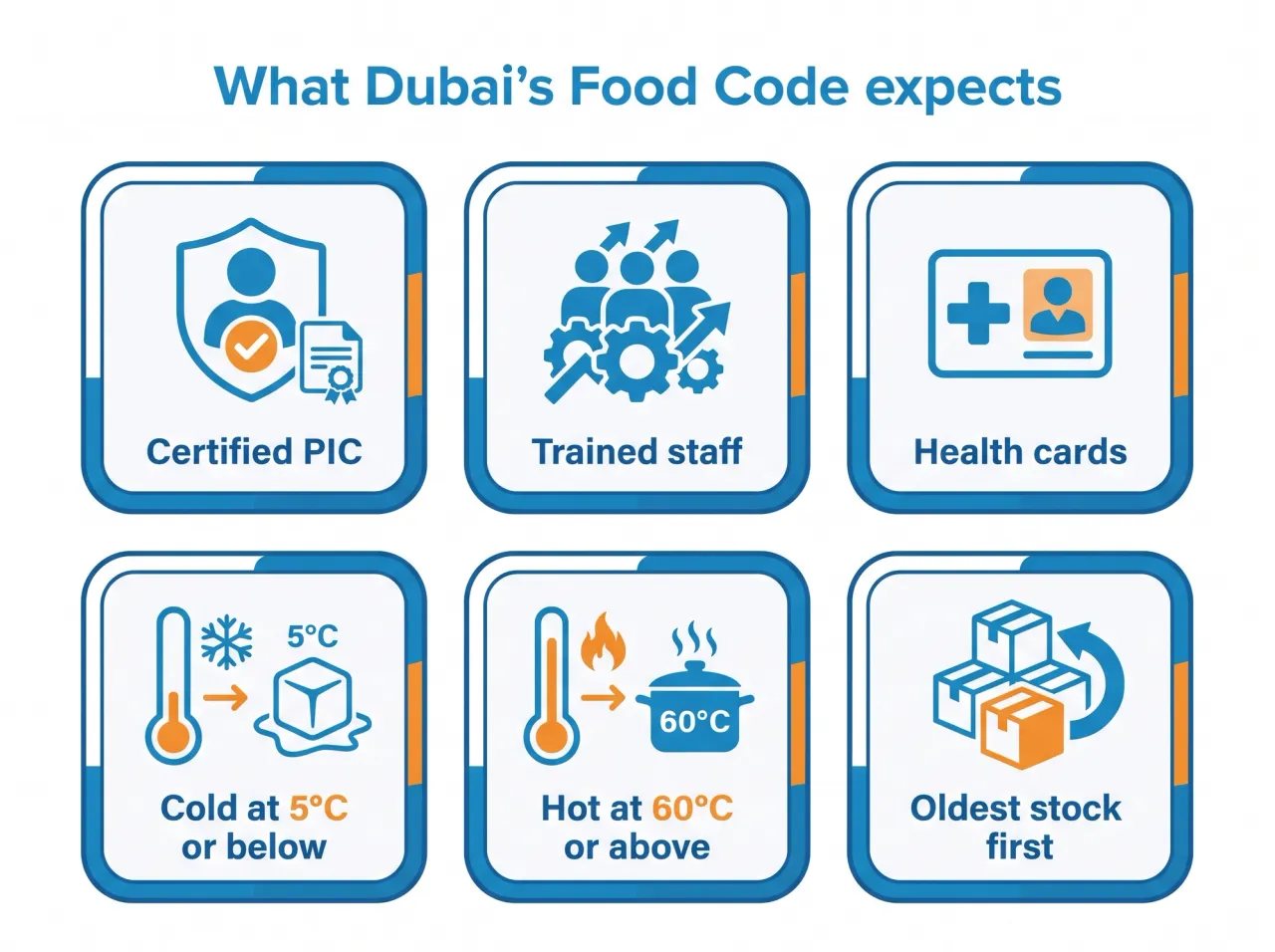
Dubai Municipality's food safety rules for restaurants come down to six things: a certified person in charge on site, trained staff with health cards, high-risk food kept at 5°C or below or 60°C or above, clean and organised storage with the oldest stock used first, declared allergens, and the hygiene facilities to back it all up. They're set out in Dubai's Food Code, and inspectors check them on every visit.
This guide walks through each rule as the Food Code and the municipality's training guideline set it out, what it means in a working kitchen, and what an inspector looks for. Requirements are updated from time to time, so check the current version with Dubai Municipality before you rely on any one detail.
What food safety rules apply to restaurants in Dubai?
Every food establishment in Dubai works to the same core requirements:
- At least one certified person in charge (PIC) of food safety
- Food safety training and an occupational health card for everyone who handles food
- Temperature control for high-risk food during storage, display, cooking, cooling and reheating
- Storage off the floor, covered, and rotated so the oldest stock goes out first
- Declared allergens, on the menu or on request
- Handwash stations, cleaning, pest control and the records that prove it
Who needs a food safety certificate in Dubai?
The person in charge
Under Dubai's Food Code, every food establishment must employ at least one full-time, on-site person in charge certified in food safety. Where high-risk, ready-to-eat or raw food is prepared, a certified PIC has to be present on every shift. The PIC passes a written exam, and the certificate is valid for five years.
Plan the rota around it. If your only PIC is off or leaves, a restaurant that prepares raw or high-risk food is out of compliance until someone else is certified.
Food handlers
Dubai Municipality's training guideline requires all food handling staff, supervisors and managers to be trained in food safety for the work they do. The basic programme is three learning hours, or five for the food service version, with a two-hour refresher, and the basic certificate is issued without an expiry date. The Food Code also expects food handlers to pass a medical fitness test and keep an occupational health card. Anyone with symptoms such as vomiting, diarrhoea or fever must stay away from handling food.
What temperatures does Dubai's Food Code set?
The Food Code treats 5°C to 60°C as the danger zone, where bacteria multiply. The numbers to train your team on:
- Keep high-risk food at 5°C or below, or 60°C or above, in storage, on display and in transport
- Cook food to a core temperature of at least 75°C
- Cool cooked food from 60°C to 20°C within two hours, then to 5°C within four more hours, and use it within 72 hours
- Reheat to above 75°C within one hour before hot holding
- Freeze food intended for frozen storage at -18°C
Cooling is where most kitchens slip. A deep pot of stock or rice can sit in the danger zone for hours, so cool in shallow trays and give containers space in the fridge so cold air can move around them.
How should a restaurant store and rotate stock?
Store food and equipment at least 15 cm off the floor, in suitable containers, covered. Rotate stock so it follows the first-in, first-out rule: the Food Code says food taken out of storage should always be the oldest stock you have.
Many kitchens go one step further with first expired, first out (FEFO): when two batches have different expiry dates, use the one that expires first, even if it arrived later. That only works if every container is labelled with its date, so make labelling part of receiving, not something done later. And every food preparation area needs at least one handwash station, with liquid soap and paper towels.
Do Dubai restaurants have to declare allergens?
Yes. The Food Code lists nine groups that must be declared when they're in a dish: crustaceans, peanuts, soybeans, tree nuts, sesame, fish, egg, milk, and cereals containing gluten. For food prepared to eat straight away, the allergen information must be displayed or given to the guest on request. Keep separate knives, boards and utensils so allergen-free dishes stay that way.
Most inspection problems I've seen weren't about a missing certificate. They were a fridge running warm or a tray of prep with no date on it. Those are daily habits, and they're the first things an inspector opens.
What does Dubai Municipality check during an inspection?
Inspectors look at how the kitchen runs on the day, not just the paperwork. Expect them to check that a certified PIC is present, fridge and hot-holding temperatures, date labels and stock rotation, storage heights, handwash stations, cleaning and pest control, and your records. Dubai Municipality grades the establishments it inspects, and a poor grade can stop you getting other permits, such as one for a food truck. Unless the municipality grants a waiver, establishments also need a written food safety programme, audited by a third-party auditor that Dubai Municipality approves, and must keep the audit reports from the last four years.
Layout matters too. Food should move one way through the kitchen, from receiving to storage, preparation, cooking and service; our guide to opening a cloud kitchen in Dubai covers what that means for a new unit. If you're still opening, our UAE restaurant opening checklist shows where the food permit fits in the timeline.
Where Quickbuy fits
Quickbuy doesn't keep temperature logs or allergen declarations, so those stay on your own checklists. What it covers is stock. Each ingredient and batch carries an expiry date, the inventory list flags expired stock, and orders draw down the batch that expires first. When food is thrown away, staff log it as waste or spoilage with a reason, so you have a record of what was binned and why, and your recipe costs stay accurate.
Waste you can see is waste you can cut. Our guide to food cost percentage shows how spoilage feeds straight into your margins.
Frequently Asked Questions
What food safety rules apply to restaurants in Dubai?
Dubai's Food Code requires a certified person in charge, trained food handlers with occupational health cards, temperature control for high-risk food, clean storage with stock rotation, declared allergens, and hygiene facilities such as handwash stations and pest control. Dubai Municipality inspects against these rules.
Who needs a food handler certificate in Dubai?
Everyone who handles food, plus supervisors and managers, must be trained in food safety for their role, and food handlers need an occupational health card. At least one certified person in charge must work on site, and on every shift where high-risk or raw food is prepared.
What is FEFO?
First expired, first out. When batches have different expiry dates, you use the one that expires first, even if it arrived later. Dubai's Food Code requires stock rotation so the oldest food leaves storage first; FEFO applies the same idea to expiry dates.
What temperature should food be kept at in Dubai?
High-risk food should be kept at 5°C or below, or 60°C or above. The Food Code also says to cook food to at least 75°C at the core, reheat above 75°C within an hour, and freeze food for frozen storage at -18°C.
Make food safety a daily routine
Dubai's food safety rules are clear, and most of them are daily habits: temperatures checked, containers dated, the oldest stock used first and a certified PIC on shift. Build them into opening and closing checks, and the inspection takes care of itself. When you want expiry dates and waste tracked with your stock, see Quickbuy's plans and pricing.