
On this page
- What goes into a restaurant business plan?
- How do you write the concept and market sections?
- What should the location and operations sections cover?
- How do you build the financial plan?
- How do you work out break-even for a Dubai restaurant?
- What tax lines does a UAE restaurant plan need?
- What mistakes do restaurant business plans make?
- Where Quickbuy fits
- Frequently Asked Questions
- Write the plan, then use it
A restaurant business plan sets out what you'll open, who it's for, where it will be, how it will run and, above all, the numbers: what it costs to open, what it will sell and when it breaks even. In Dubai, investors and partners will ask for one, and mall landlords often want to see the concept and the financials before they offer a unit. Even if nobody asks, writing it is the cheapest way to find out whether the idea works before you sign a lease.
This guide walks through each section, shows how to build the financial plan in dirhams with a worked break-even example, and covers the VAT and Corporate Tax lines a UAE plan needs. The figures in the examples are illustrations, not quotes, so replace them with your own.
What goes into a restaurant business plan?
Most plans follow the same eight sections, and lenders and investors expect them in this order:
- Executive summary: the concept, the location, the money you need and when it pays back, on one page
- Concept and menu: cuisine, service style, price point and average spend per guest
- Market and competition: who your guests are and who else is feeding them nearby
- Location and lease: the unit, the rent and the terms
- Operations and team: opening hours, seats, staff, suppliers and systems
- Marketing: how the first guests will find you, and why they'll come back
- Financial plan: opening costs, sales, running costs, break-even and cash flow
- Funding and risks: where the money comes from and what happens if sales come in low
Write the executive summary last. It summarises decisions you make in the other seven sections, so it can't be written first.
How do you write the concept and market sections?
Describe the concept in one sentence a stranger would understand: what you serve, how, and at what price. Then make it specific. Give the average spend per guest, the number of dishes on the menu, the service style and the food cost you're aiming for on each dish. A concept that can't name its average spend isn't ready for a financial plan.
For the market, walk the area at lunch and dinner on weekdays and at weekends. Note who is there, what the nearest competitors charge and how busy they are, and check the delivery apps for the same cuisine nearby. Dubai trade also moves with the calendar: footfall in tourist and outdoor areas drops in the summer months, and Ramadan changes trading hours for a month. A good plan shows that it knows this.
What should the location and operations sections cover?
The location section is where the plan meets the lease. Give the unit size, the rent per square foot per year, the deposit and payment terms, and any rent-free period for the fit-out. Commercial rent in the UAE carries 5% VAT. Prime mall and high-street units can cost several times more per square foot than value areas, so the location changes every number that follows.
Operations is how the restaurant runs day to day: opening hours, seats, the covers you expect at each service, kitchen and floor roles, headcount per shift, main suppliers and the systems you'll use for orders, payments, stock and accounts. Keep it practical. An investor reads this section to see whether you've run a service before.
How do you build the financial plan?
The financial plan is four numbers, built in this order: what it costs to open, what you'll sell, what it costs to run, and where sales and costs meet. Work in net sales throughout, without VAT, because the 5% you collect from guests is owed to the Federal Tax Authority.
Opening costs
List every line you pay before the first guest: licences and permits, fit-out, kitchen equipment, furniture, the rent deposit and the rent you pay during the fit-out, pre-opening salaries and training, opening stock and launch marketing. Then add working capital, the cash that carries you through the months before sales settle. Our guide to the cost to open a restaurant in Dubai has the 2026 ranges for each line.
Sales
Build sales from the bottom up: seats, covers per service, services per day, average spend and trading days. A 60-seat restaurant that fills every seat once at lunch and once at dinner is doing very well, so plan for less. Make three versions: a realistic case, a slow case with sales 30% lower, and a good case. Use the slow case to decide how much cash you need.
Running costs
Split monthly costs into variable costs, which rise and fall with sales, and fixed costs, which you pay whatever happens. Rules of thumb to test the plan against:
- Food and drink cost: about 28 to 35% of sales for most restaurants (our food cost percentage guide breaks it down by format)
- Prime cost, food and drink plus labour: ideally under 60 to 65% of sales. In the UAE, labour includes visas, medical insurance and housing or allowances
- Rent: a common rule of thumb is around 10% of sales or less
- Everything else: card fees, packaging, utilities, marketing, insurance and the yearly licence renewal
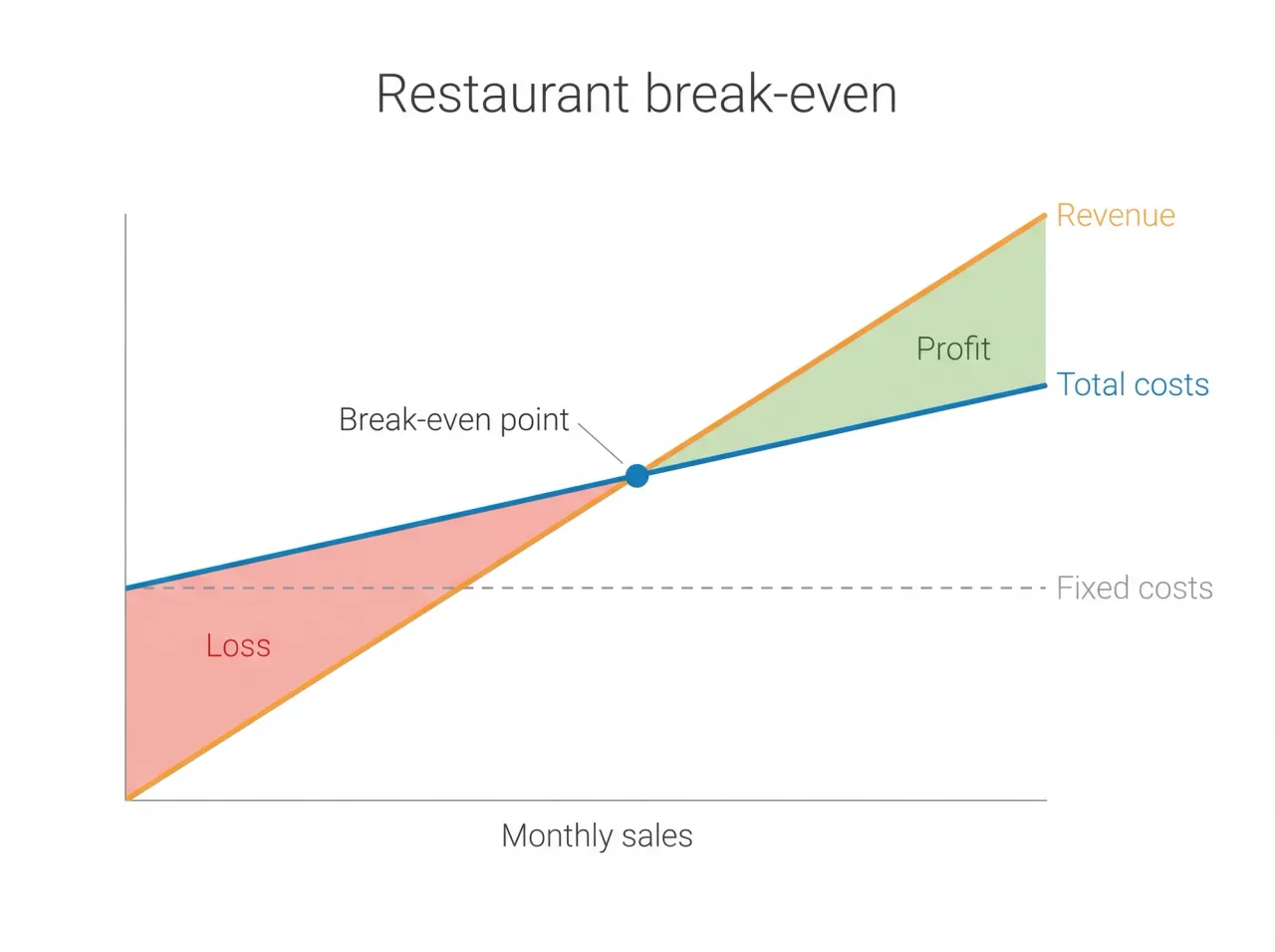
How do you work out break-even for a Dubai restaurant?
Break-even sales are your fixed costs divided by the share of each dirham left after variable costs. Here's a worked example for a mid-sized restaurant, with illustrative numbers:
- Fixed costs: AED 95,000 a month (rent AED 30,000, salaries and staff costs AED 55,000, utilities and other fixed costs AED 10,000)
- Variable costs: 35% of sales (food and drink 32%, card fees and packaging 3%)
- Left from each dirham of sales: 65 fils
- Break-even sales: AED 95,000 ÷ 0.65, about AED 146,000 a month
- Per day over 30 days: about AED 4,900, or about 58 guests at an average spend of AED 85
That daily number is what makes the plan useful. If your realistic case only reaches 45 guests a day, the plan has told you to change the rent, the prices or the concept before you commit. Then work out payback: if the realistic case makes AED 25,000 a month in profit, a AED 600,000 opening budget takes 24 months to earn back, before tax.
What tax lines does a UAE restaurant plan need?
Two. VAT is charged at 5%, and registration is mandatory once taxable supplies pass AED 375,000 over 12 months. You can register voluntarily from AED 187,500, which lets you recover the VAT you pay on the fit-out and equipment. Corporate Tax is 0% on taxable income up to AED 375,000 and 9% above it, as the UAE government's Corporate Tax page sets out.
Small Business Relief lets businesses with revenue of AED 3 million or less be treated as having no taxable income, but under the current decision it only covers tax periods ending on or before 31 December 2026. A plan for a restaurant opening in 2027 should assume Corporate Tax applies. Our guide to restaurant bookkeeping in the UAE covers the records you'll need, and a registered tax agent can confirm your position.
The plans I trust are the ones with a bad month in them. Write down what happens if sales come in 30% under, and how many months of cash you have to ride it out.
What mistakes do restaurant business plans make?
- Sales built on full tables at every service from the first week
- No rent for the fit-out months, which can run for several months
- No working capital, so the first slow month becomes a crisis
- Food cost guessed from menu prices instead of costed recipes
- Every month treated the same, with no slower summer or Ramadan month
- One version of the numbers, with no slow case
Where Quickbuy fits
A business plan is only useful if you check it once you're open. Quickbuy's restaurant accounting gives you a profit and loss report for each branch, with net revenue, cost of goods, gross margin, operating expenses and net income, so you can hold the real month against the plan line by line. The sales dashboard shows the day's revenue, orders and average order value, so you can check each day against the daily break-even figure from your plan. Each menu item also shows its recipe cost next to its price, so the food cost in your plan is the food cost you actually run.
Our guide to the restaurant profit and loss statement explains how to read each line of that report and what to do when one drifts.
Frequently Asked Questions
What should a restaurant business plan include?
An executive summary, the concept and menu, the market and competition, the location and lease, operations and team, marketing, a financial plan with opening costs, sales, running costs and break-even, and how you'll fund it. In the UAE, put VAT and Corporate Tax into the numbers.
What is the difference between a business plan and a feasibility study?
A feasibility study asks whether the idea can work: is there demand, what will it cost and will it make money. A business plan assumes the answer is yes and sets out how you'll build and run it, and it's the document you show lenders and partners. The financial sections are the same, so many owners write one document that does both.
How do you calculate break-even for a restaurant?
Divide your monthly fixed costs by the share of sales left after variable costs. With AED 95,000 of fixed costs and variable costs at 35% of sales, break-even is AED 95,000 ÷ 0.65, about AED 146,000 a month or AED 4,900 a day.
Is a restaurant business profitable in Dubai?
It can be, but margins are thin and rent decides more of the result than most owners expect. That's why the break-even line matters. If your realistic sales clear it with room to spare, the concept can work. If they only just reach it, change the plan before you sign the lease.
Write the plan, then use it
A restaurant business plan for Dubai doesn't need to be long. It needs honest sales, every opening cost, a break-even you can say out loud and enough cash for a slow start. Once you open, check the real numbers against it every month. When you're choosing the systems you'll open with, see Quickbuy's plans and pricing.